Thursday, April 01, 2021


Back to the Fusion

A recap of my Fusion Sport's first six-months.

  Pirate Press         April 2021


On the Fusion's six-hour drive home from Georgia last October, I had plenty of time to formulate an attack plan for what needed to be done to bring it in line with my (admittedly) high standards. After all, a Ferrari, Corvette and 300-hp Saturn are tough acts to follow.


Obviously, the first thing I wanted to address was the standard maintenance items (which I assumed correctly) had been neglected. I also saw this on my Red Line, which had similar mileage as the Fusion (~30,000 miles) when I bought it. Typically, one-owner cars like my Saturn and Ford benefit from better upkeep than a car that's had multiple owners. But, it seems that if the original owner suspects they will be selling it soon, they deliberately avoid replacing the typical wear items in an effort to pass those expenses along to the dealer or new owner. And while this is morally reprehensible, it's nonetheless accepted as sacrosanct by sellers looking to squeeze as much perceived value from their trade-in as possible.

At Gary Yeoman's Ford in Daytona Beach where I bought my Red Line, they promised a "135 point safety check: The Service Department will check your vehicle to make sure components such as brakes, windshield wipers, lights and much more are in proper working order and that you won't experience any unexpected problems." This was typical, perfidious stealership rhetoric as not only did I receive a check-engine light before I even made it back to Mississippi that cost $635 to repair, but the tires were dry-rotted and worn, with one blowing out a year later. Additionally, the front axle was leaking, the windshield wipers were shot, and both air-filters and fuel filter were filthy and had never been changed. I can't imagine any legitimate "safety check" that excludes these essential items.

Thankfully, I was treated slightly better at Heritage Nissan when I bought the Fusion: It had brand-new OEM Goodyear Eagle RS-A tires, the wiper blades worked well (for the hurricane we drove through), and the oil was fresh. Unfortunately, the antifreeze and accompanying air filters were the worst I've ever seen, as if the ex-owner had driven up and down every dirt road in Georgia for the vehicle's entire 34,000 miles.. Heritage Nissan claims "We fully inspect the vehicles before we sell them to be confident that the vehicle is in great condition" but there's no way even a cursory glance of the coolant or filters should have passed muster.

It's hard to tell from the photo, but there was a frightening amount of sediment in the coolant tank. I've gone 100,000 miles in my vehicles and never seen antifreeze even remotely close to the muck present in the Fusion. In fact, I was so concerned that as soon as we got back to Mississippi, I called Estabrook Ford to arrange an immediate flush. They couldn't fit me in for several days, so I ended up taking it to Clark's Professional Car Care, an independent shop I've come to trust. Speaking with the owner Derek, he instantly arranged for me to bring it in and had it finished before lunch. The result was new coolant that looked clean enough to drink, although he wisely advised against it. 

Truthfully, I could have changed the fluid myself, but with the Fusion's cumbersome underbody tray and fragile plastic petcock, I didn't want to risk damaging it. Fortunately, replacing the engine air filter was much easier since I no longer had a supercharger in the way as I did with the Saturn. I was tempted to pick up a K&N filter for it, but after the issues with a K&N on our 2006 Freestyle and the damaged MAF sensor, I decided against it. 

The original engine air filter was a dingy orange color, both from the age and mileage. If not for the identical dimensions, I'd never have imagined that they were for the same car. 

But the cabin air filter was the absolute worst, with it hardly recognizable as ever originally being white. And further inspection revealed just how filthy it really was, with tons of dirt and crud jam-packed in every pleat.


I was largely pleased with the exterior cosmetics, aside from the ridiculously priapistic roof antenna. I've never been a fan of antennas, even going so far as to completely remove the one from my Saturn. For the Fusion, I looked at buying a custom, color-matched shark-fin style replacement, but it would have required prying off the factory one and gluing on the new one, which I was opposed to. Instead, I simply bought a "stubby" replacement that screwed onto the original base, but reduced the overall height by almost two-thirds. Even better, the mini-antennae only cost eight dollars and I received it in a couple days, versus $80 and four weeks for the aftermarket one. Best of all, my reception hasn't suffered one bit.

 
Yet even with aggressive 18" rubber and a stiffer suspension, the handling still felt a little soft compared to the grip I'd become accustomed to in the Red Line and Corvette. So, to combat that I ordered a Steeda Strut Tower Brace, which offers the most bang-for-the-buck and easiest installation of any performance part in my experience. For $100 and a 5-minute job, I know of nothing else that comes close!  


The other area where I felt the Fusion was lacking was in the factory exhaust, which despite the low-restriction mufflers exclusive to the Sport model, was still just too quiet for my taste. And while I really wanted some glorious long-tube headers to help the V6 exhale, I was dismayed to find that they weren't available at any price. And with Ford's deplorable decision to integrate the catalytic converters into the manifolds, I was effectively hamstrung from opening up the exhaust. In short, that left my only feasible modification as an aftermarket muffler system. 
 
And with only one brand available, it certainly helped narrow down my options, so I reluctantly picked up a MagnaFlow cat-back system. Curiously priced at $1,405.18, I wondered how they arrived at that unusual sum and if the extra 19 cents really made that much of a difference over pricing it at $1404.99? But I understood that it was shipping out of Canada, so maybe the foreign exchange rate was somehow to blame for the usual amount. 
 
Regardless, it was the most expensive exhaust system I've ever purchased, not counting the Ferrari's $5000 Fuchs Titanium muffler which (technically) came with the car. And I've certainly had some other esoteric exhaust choices over the years, such as Cherry Bombs on my 1990 Mustang GT, and an aluminum Thermal Research & Development system on my 1997 Saturn SC2. 
 
Interestingly, the MagnaFlow packaging states the exhaust is designed for "GM-Isuzu" with no mention of Ford whatsoever. The cross-compatibility with GM is plausible, but the Isuzu association is what's really perplexing as the brand hasn't been sold in North America in over a decade. Once again, it looks like it might have something to do with the Canadian market as Isuzu is thriving there.


The box was so big that I actually had to pick it up in my wife's SUV and fold down the rear seat so it would fit. Despite it's heavy and cumbersome nature, it was nonetheless packaged well with a plethora of protection to prevent the shiny stainless steel pipes from getting scratched up. Aside from the gleaming 4" exhaust tips, I lamented to Amanda that's it's a shame the entire exhaust is obscured during daily use since it's such a work of art.  

 
As with the radiator flush, I dropped it off at Clark's for the installation which I'd read was pretty basic and straight-forward. Befitting the premium nature of the system (all the exhaust hangers and such were already welded on) it was truly a bolt-on affair. Many reviewers stated they replaced it in their own garage or driveway without the benefit of a lift in an hour or less, so I though it should really be a piece of cake for Clark's with their lift and power tools. But as with my luck, they claim to have run into some issues which really drove the labor up, costing me a whopping $375 to install it!   

And as if that wasn't painful enough, I'm just not a big fan of the new exhaust tone. MagnaFlow advertises a "Smooth Deep Tone" yet it's nothing like I imagined. Granted, it's definitely better than the stock system, but still way too muted for my liking. It's pretty disappointing considering the time and money I invested into it. To "correct" the perceived lack of sound, many owners have resorted to gutting the cats and replacing the MagnaFlow resonator with a straight pipe. I'm not going that route as I fear it will make the exhaust sound too raspy, but strangely enough, I'm enjoying my first daily driver in 30 years with catalytic converters. Although my eco-friendly decision is unlikely to offset rising ocean levels, I certainly don't miss the noxious fumes or having to constantly clear the check engine light. 
 
At Christmas, I bought a kit from Steeda that  hyperbolically claimed to be the "Ultimate Induction Power Pak." For $669.95, it included a Cold Air Intake, Throttle Body Spacer, SCT X4 handheld programmer and a "Mail Order Custom Tune." But using the word's "Mail Order" and "Custom" in the same sentence is about as legit as claiming "Real Faux Pearls." It was basically a generic canned tune since I couldn't do any data-logging or use a wide-band 02 sensor. Even worse, several forum members came forward stating that aftermarket tunes had been responsible for cam phaser issues which effectively grenaded their engines. That and the pricey requirement for 93 octane (now almost $4/gal.) thoroughly ruined my enthusiasm for using it. Likewise for the Cold Air Intake, which was said to fit poorly and actually perform worse than the factory airbox. Finally, there was no proof that the Throttle Body Spacer actually did anything, so I sold the entire kit. 


But clearly for most people the Fusion already provides more than enough power and handling. It's 3.5-liter V6 is one of the largest you can buy in a production car, and imparts a near 50/50 formula of  low-end torque (249 lb-ft.) and high-rpm horsepower (265). Just ask my daughter (with her freshly printed Learner's Permit) who inadvertently gunned it merging onto the highway without realizing the engine's responsiveness. God bless Ford's AdvanceTrak Electronic Stability Control (ESC) or it could have been a lot worse than us simply ending up in the oncoming lane.
 
 
Perhaps for reasons such as teenage drivers, ESC cannot be turned off, but Traction Control (TC) can. Disabling TC produces a livelier, far more fun version of the Fusion, like Miley Cyrus on Molly. It enthusiastically spins the beefy 18" front tires and with the Variable Valve Timing (VVT) eagerly surges ahead as the tach rips past 4500rpm. Max power is achieved at 6250 and the six-speed auto upshifts at the 6500 redline. Or choose the SelectShift manual mode, and the tach will impressively bounce off the rev-limiter until the next gear is chosen. And while it does keep the engine near peak output, it's certainly not recommended if longevity is a concern.

Of course, the Fusion isn't a one-dimensional car like my Ferrari or Corvette which looked great but were terrible to drive, and I suppose that's why I've become so enamored with it. As my daily driver, 95% of the time I just need something to safely and reliably ferry me to work and back without any drama. It's the other 5% that I get to exercise the "Sport" designation in the Fusion's name. Unfortunately, leaving my job at the same time as the Drug Task Force agents and the Sheriff' Deputies means I need to be on my best behavior. Despite that, the patrol cars are easy to spot and they usually drive faster than me. Likewise, the Task Force trucks try so hard to be incognito that the reverse happens and they're pretty unmistakable with their all-black paint jobs and (ironically) illegally tinted windows. 

However, there have been a couple instances where I've been able to "exercise" the Fusion and ensure that all 265 ponies are present and pulling. The first was a Hyundai Genesis 2.0 Turbo Coupe that I was behind as we waited to turn onto Highway 63. I figured he might mistake my Fusion for the slower four-cylinder variant (which is what I've encountered myself) and try to leave me in his dust.  When the light turned green, we both rolled out and I promptly moved into the right lane so I could pass him. But judging from the wide-open wail of his exhaust and his acceleration, it was clear that he was racing and I was having to play catch up. In spite of my initial car-length deficit, the Fusion's V6 was noticeably making more power and I was steadily gaining on him. By 80 mph, I had run him down and was passing him when he suddenly hit the brakes. In street racing parlance, we call this type of cowardly forfeiture "the loser's weasel" because he was attempting to squirm his way out of a confrontation that he irrefutably lost. And when I looked it up later I saw why— his turbocharged four-cylinder was only rated for 210 hp, a deficit of over 50 hp compared to my Fusion. And given nearly equal curb weights of 3,300 lbs., he wasn't going to win even with an unfair head start. To put that difference in perspective, my Fusion is a full-second faster to 60 mph, 3 seconds faster to 100 mph, and a whopping 10 seconds faster to 130 mph! Heck, at that rate I don't blame him for giving up!

The second race was much more improbable, but not that unlikely given the local rednecks' fondness for full-size trucks. Admittedly, I'm not much on knowing specific models of trucks, other than recognizing that it was a big, newer-model Dodge. Unbelievably, as I sat at the same traffic light where I had raced the Genesis, this grinning hillbilly began revving his engine and scooting closer and closer toward the intersection. He was undoubtedly attempting to bait me into a race and I was more than happy to oblige! 

At least this time I was side-by-side with my opponent so it was on a more level playing field. And as the light changed, we both tentatively pulled across the intersection. I was waiting until my front tires were pointed straight ahead before I applied full throttle. Ford's traction control is mildly effective, but it's certainly no limited-slip differential when attempting to put the power down in a curve. With 17-inch tires on my Saturn, I was accustomed to excessive wheel spin and I felt the Fusion's 18-inch rubber would mitigate that issue. However, it appears that 19-inch wheels are now what I need, even though that size was previously reserved for super cars like the $250,000 Ferrari California I drove in New Orleans.

But once we had circumnavigated the traffic median and I was pointed straight ahead, I smoothly squeezed the throttle down, hoping not to break traction. Painting twin black strips down the highway in an acrid haze of tire smoke looks mightily impressive in the movies, but in the real world it's anathema to acceleration. Or like they say at drag strips, "Spinning ain't Winning!"

Unfortunately, Ford's programming of the six-speed transmission tends to err on the conservative side, favoring fuel economy and reliability over optimized shift points, so it can be a little lazy at times and this happened to be one of those occasions.  As such, it was like starting a race in second gear, which is essentially what happened. Even so, we were dead even until around 60 mph when the Dodge's Everest-like aerodynamics really came into play and it began to struggle with the exponentially increasing wind-resistance. By 80 mph, he was several car-lengths back and I felt confident in tapping my brake lights to signal that I was slowing down. In a perfect world where I wouldn't have to worry about possible incarceration or vehicle impoundment, I would have happily sailed up to 100 mph or more, thereby heaping even more humiliation upon him. Of course, even though I let off, he continued to roar past me in a petulant display of defiance. But, he only succeeded in getting hemmed in by traffic further ahead, whereby I joyfully passed him again (legally this time) leaving me to ask "Who's smilin' now, buddy?"

Another race improbably took place just as I was starting my day. I had puttered to the end of my street and was waiting to pull onto Hwy 63. There's always a speeding glut of morning commuters so I'm accustomed to having a delay until it's clear. I spotted an oncoming maroon truck in the first lane with his blinker on so I figured he was turning at my road which isn't uncommon. Based on that knowledge, I went ahead and pulled out only to discover that he wasn't turning. Furthermore, Bubba incorrectly believed that I would slow him down so he swerved into the second lane with the idea of blowing past me. Much to his chagrin, that didn't happen as I kept the accelerator pedal firmly pinned to the floor. With the transmission redlining at 6500rpm in first and second gear, I had matched his speed just as he drew alongside. But rather than acknowledging his misconception about me, he furiously attempted to pass. Nonchalantly, I continued to keep the throttle buried until I saw an indicated 95 mph and he was a couple car lengths astern. I then calmly let off, broadcasting the notion that I begin everyday by casually hitting 95 mph as I pull onto the highway. The four doors and sedan body are very effective at this ruse, as no one expects it to be as quick as it is. And believe me, it works even better than a Starbucks Tripleshot at waking me up! 

Finally, the most exciting race was with a 2013-era Mustang V6. It could have been a 2014 model, as both sported the LED headlights and tail lamps, but I couldn't tell for sure. What I was certain about was that it possessed a similar, albeit larger and more powerful version of the V6 in my own car. At 3.7 liters and 305 horsepower, it had a 40hp advantage, but was also around 200 lbs heavier. I initially hadn't intended to race him, but after he needlessly and aggressively flew around me, I decided that he had earned a serving of humble pie!

From his belligerent passing maneuver, it was also clear that he was sporting some type of obnoxiously loud aftermarket exhaust. However, given the clearly neglected condition of the car, I confidently concluded that it was most likely some cheap mufflers instead of a premium cat-back system like mine. 

I was surprised to discover that his car was a six-speed manual, as he continuously revved it during our confrontation. The first two races were from 70mph+ highway rolls, and both times I pulled away from him so hard that I wondered if maybe he wasn't prepared or ready? But there would be no refuting our third and final race as I was stopped behind him at a traffic light. Once the light turned green, and we threaded our way through the traffic in front of us, we had an open four-lane and no excuses. I purposely let him get the hit, and then I followed suit, absolutely smashing the gas pedal to the floor. And while I've found that the Fusion's automatic six-speed can be reluctant at times (see above), this was not one of them, as it banged through the wide-open-throttle redline upshifts faster than I could have done it myself. 

In the heat of the moment, I saw the Fusion's glowing speedometer needle sweeping past 110 mph and I realized I needed to slow down immediately in case there was a State Trooper ahead. But that was the only alarming element, as from a mechanical standpoint the Fusion was absolutely rock-solid with no nervous characteristics. With it's huge rear-spoiler and ground-effects package, my Red Line produced more road-hugging downforce, but it was at the expense of aerodynamic drag. Checking the coast-down measurements of my Ford versus my Saturn, it's clear the Fusion possesses a much more slippery shape, and might actually accelerate quicker above 100 mph than the Red Line despite the power gap. I'll hopefully have an opportunity in the future whereby I can prudently poke the Fusion through 120 mph, much like like I did with the Corvette and Ferrari, to test its high-speed handling. And as for the Mustang, I later read that due to driveshaft failures, the V6 model is limited to 112 mph, so even though he was several car lengths behind, he would never have caught me. Aside from that, I'm at a loss to speculate why it didn't perform better.  

And while it wasn't as thrilling, I did drive the Fusion in the coldest weather I've ever experienced. Thanks to Winter Storm Uri, it was the chilliest Mardi Gras in history, breaking a record set back in 1893. The frigid temps also had a very pleasant side-effect, temporarily increasing my horsepower roughly 10% due to the denser air. Unfortunately, it seemed to coincide with a corresponding decrease in traction from the cold asphalt, which predictably nullified my ability to use said extra power. Even so, it spawned a delightful game of tug-of-war between my engine and ECM; Taking off from a standing start, the tires would begin to spin at 3000rpm wherein the computer would sense the slippage and begin to pull timing. However, I would keep my foot in it so that the engine was developing more power and I would let them fight it out. It produced a pretty amusing contest, although having the front wheels spin at 60 mph can be slightly unnerving.    

Lastly, I didn't realize it when I bought it, but it was satisfying to discover that the Fusion holds the Dollar-per-Horsepower crown of all my car purchases. My equation assigns a vehicle's value based on the price divided by the horsepower (i.e. the cheapest performance). New cars are traditionally terrible at this as a new 2021 Corvette commands roughly $200 per horsepower ($100,000 \ 495 HP). Sadly, my Ferrari boasted a similarly poor ratio, but there was nothing rational about it. However, my 2002 Corvette represented a much better investment at around just $35 per horsepower. The formula also bases the intrinsic value on the factory produced power, not any aftermarket amount, as that can be burdened by a variety of variables. For instance, my Red Line had 205 hp when I bought it, but was later modified to produce 310. Even factoring in the cost of the upgrades would still tremendously skew the overall Dollar\Horsepower rating. 
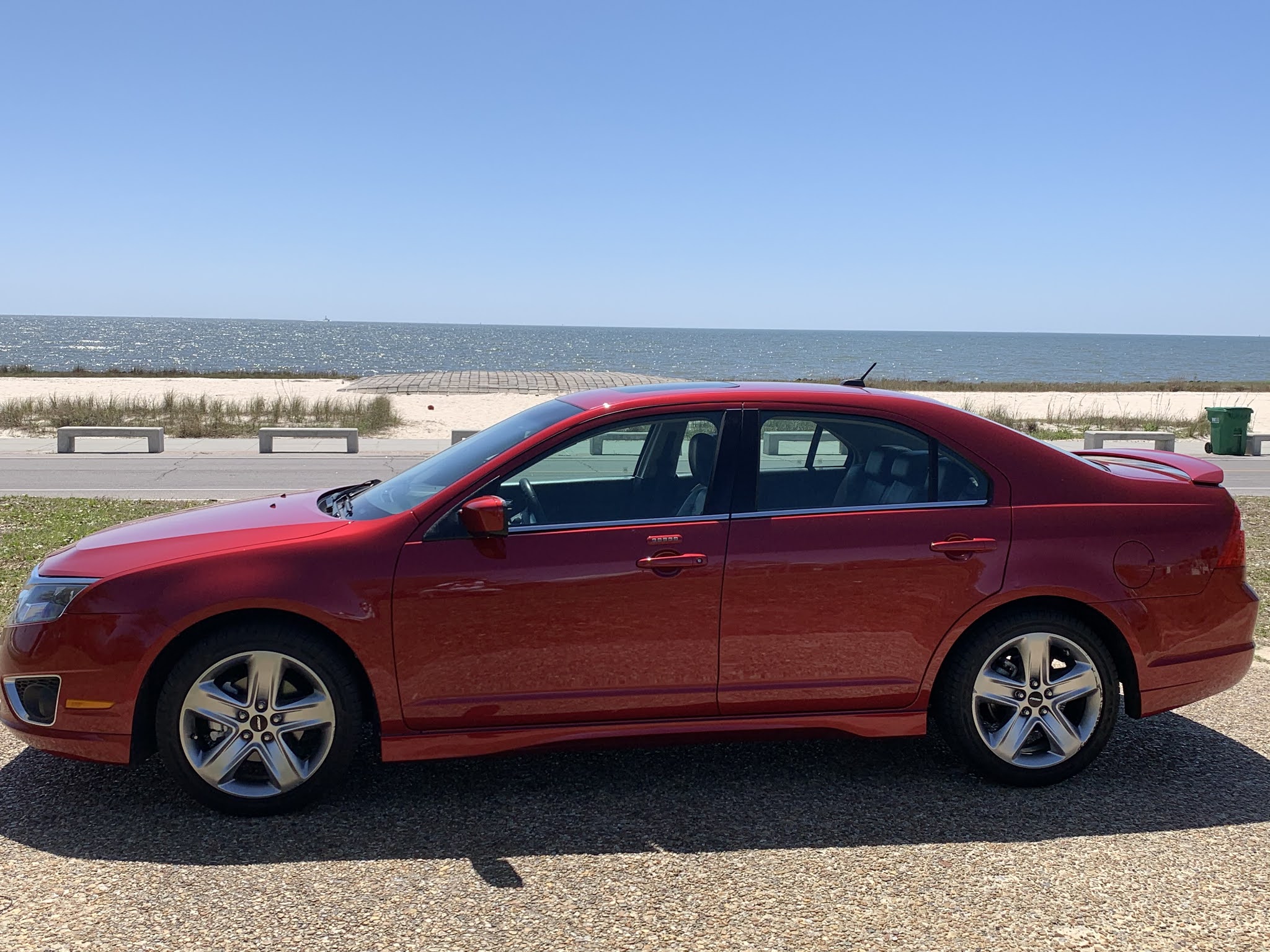

As for memorable events, I can also promise that my wife enjoyed her first ride in the Fusion much more so than in either the Ferrari or Corvette. Now, I'm fully aware how such a bold statement may be greeted with a healthy amount of skepticism. After all, we had a great dinner date in the Ferrari and saw a wonderful concert in the Corvette. So what could possibly be more endearing than that?
 
How about leaving the hospital? That's right, after three days in ICU Amanda was discharged and it coincidentally happened to also be her first ride in the Fusion. To say she was thrilled to be sitting in it was an understatement, as with Covid cases raging, she had been isolated from everyone. Even Victoria and I couldn't see her, since our only contact was calling the Nurse's desk.          

And as we faced the unpredictable wrath of Mother Nature, the Fusion's first six months of ownership were arguably more "exciting" than that same time with any other car I've ever owned. Not only did it endure the aforementioned sub-freezing temperatures of Winter Storm Uri, but it also survived our driving through Hurricane Delta. In my lifetime, it's been exceedingly rare to encounter either of those events, but to experience both within 120 days of each other was historically unprecedented.

Truthfully, no car is perfect, but the Fusion is undeniably the most well-rounded automobile I've owned to date. I recently bragged to my wife how enjoyable it was to drive, and she sarcastically remarked that it shouldn't take me long before I screw that up. I laughed, but she had a point: Engine upgrades increase the wear and fuel consumption, suspension parts degrade the ride quality, etc. Modifying any car is a slippery slope, so I'm trying to tread lightly and improve it without destroying it. 

Wish me luck!          

Monday, February 01, 2021

Amped Up!

Testing Ampere, Nvidia's Newest Graphics Gamebuster

  Pirate Press         February 2021


2020 was admittedly the strangest year in modern history, fraught with such bizarre shortages as vaccines, food, toilet paper, and, um, video cards.

Wait. What?

Yep, as perplexing as it may sound, it was nearly impossible (unless you were friends with Bill Gates or Jeff Bezos) to purchase any of the new video cards from Nvidia or AMD that were released last fall. 

Even more dumbfounding is that with over 40 million Americans losing their jobs and unemployment at higher levels than the Great Depression, economists believe that discretionary purchases like a $700 video card are not only callous, but unthinkable. 

Yet leave it to a crazy pandemic to turn the world upside down where nothing makes any sense.

Back in October, I promised that the new Nvidia 3080 video card I needed to complete my recent PC upgrade was in the pipeline and would be arriving soon. I even boasted that with 30 Teraflops of processing power, it would be a whopping three times faster than either the new Playstation 5 or Xbox Series X. It actually achieves 31.33, but who's counting? 😎

However, my assumption of perceived availability was based on forty years of buying PC peripherals and that clearly meant jack shit in a year where it was easier to buy marijuana than toilet paper.          

So, when 8 a.m. on September 17th rolled around, I naively believed that very few people would be lined up to drop $700 on something as silly and unnecessary as a new graphics card. 

My wife thinks I don't admit this often enough, so this one's for her: WOW, was I wrong!

The selection of 3080 inventory instantly went from available to sold-out before I could even click anything. Initially, I thought it was just poor luck on my end, until furious reports started tricking in from all over the world of kindred experiences where the cards were gone before they even appeared. In case you weren't aware, the collective "Angry Internet" is a very real thing. 

There was speculation that Nvidia didn't have enough cards to meet demand, and that automated online robots (or "bots" for short) were scooping up the cards by the dozens. Shortly after the 3080 went on sale, one user shared a screenshot bragging on social media that his bot was able to snag forty-two of them from Nvidia's website. From that moment forward, it was clear that video cards had joined the shadowy domain of online scalping which was previously reserved for the likes of popular concert tickets and limited-edition athletic shoes. It also illustrated that it was big business, as your average computer enthusiast doesn't have $30,000 laying around to blow on video cards to resell.           

I knew my odds of getting hit by a meteorite were better than me finding a 3080 for sale, so I enlisted the help of one of my employer's hardware vendors. I was told that they would receive their first shipment on October 2nd, so I gladly provided my credit card for an ASUS TUF 3080 that was priced at $785. It was nearly $100 more than the 3080's "suggested retail price" of $699, but given the lack of availability and the desire to have it in my sweaty little palms, I begrudgingly acquiesced.

But when there was no shipping notification on October 2nd, I inquired about the 3080 and discovered that the ETA had slipped almost two more months to November 30th! Even worse, our vendor had looped in the ASUS rep on the email and he was no help, simply stating the obvious: that there's always a video card shortage after every new launch. However, he conveniently neglected to acknowledge that this was not just a typical release deficiency, but rather a global shortage.

So, with no other viable options I reluctantly waited until December. Only the supply crunch didn't let up, generating even more pent-up demand for them. The shortage was so bad that it spawned countless articles and launched a thousand memes. Meanwhile, my shipping date kept getting pushed back even further, and on December 14th, I was notified that the latest ETA was now for December 30th. However, other gamers desperate to get a 3080 under their Christmas tree had resorted to paying online scalpers over $1000. Despite that, my ethics prevented me from buying such a criminally-overpriced item, and I ruefully resigned myself to the fact that I would not be getting a 3080 in 2020.

MIRACLE ON 3080 STREET

But on December 22nd, I experienced the closest thing I've ever had to a Christmas miracle— it was an email from graphics card maker EVGA stating that a 3080 FTW3 Ultra was being held for me for 8 hours if I wanted to buy it. As if that wasn't unusual enough, I couldn't even remember the last time I bought anything from them. I was fairly certain that it was a graphics card, but when I recalled the ones I'd acquired, none of them were from EVGA. My most recent video card, a 1080 Ti, was procured in 2017 directly from Nvidia. Likewise, my 1070 was from Gigabyte and my 970 came from MSI. Going even further back to 2013, I had a PNY 670 which succeeded a PNY 570 in 2011. Finally, I traced an MSI 260 all the way back to 2009, but there was still no record of any EVGA orders.  

Needless to say, I was completely nonplussed, both elated and perplexed at how I received an email for such a coveted item just three days before Christmas. My only other remotely similar stroke of good fortune came last year when my Landry's dining card was improperly credited for a $226 meal at a Morton's in Boca Raton. I haven't been to South Florida in 30 years, but I wasn't about to let that $25 dining credit go to waste. I immediately applied it to dinner at Saltgrass Steakhouse before the accounting error was discovered and rescinded.


Much like the Morton's mix-up, I figured my 3080 order would probably be cancelled, but on the off chance it wasn't, I went ahead and paid for it. Funny enough, I also had a $25 "EVGA Bucks" coupon obviously left over from whatever I bought eons ago. But given that the 3080 was still a whopping $863 after shipping and tax, it gave me serious reservations about the Rubicon I had crossed. For almost twenty years (1997-2016), I'd been able to keep my GPU upgrades to around $300 every couple of years. But with the purchase of a 1080 Ti ($699) in 2017 and now a 3080, I'm afraid I've passed a point of no return. Or as my friend observed, I practically could have bought a brand new Xbox Series X and Playstation 5 for almost the same amount of money.    


RAY GUN 

So, what is compelling otherwise reasonable and rational people to pay over $1000 for a 3080? For me, the appeal was not only faster frame rates in games, but the application of a new technology called "Real Time Ray Tracing" which Nvidia abbreviates as RTX, an obvious notch above their previous top-tier GTX acronym.

It's true that my 1080 Ti was capable of some very low-level ray tracing, but the technology was formally introduced with the 2000 series cards and was most capable on the 2080 Ti. However, because the ray tracing functionality was still in its infancy, enabling it in games introduced a significant performance penalty. For that reason, I chose to bypass the 2080 which came out in 2018, and wait for the 3080.

In any other year not dominated by unprecedented social unrest, countless wildfires, a record number of hurricanes, and a lethal influenza, it probably wouldn't have been a big deal to buy a 3080 on launch day. But 2020 became the biggest example we've ever seen of Murphy's Law, literally affecting everyone and everything on Earth.

Plus, it was also admittedly selfish reasons I wanted (and needed) a 3080. As an avowed eye-candy whore, I crave the maximum fidelity available when playing a game. And with blockbuster new titles like Cyberpunk 2077 utilizing Ray-Tracing, I didn't want to play it and not get the full, immersive experience.

Without getting too verbose, Real-Time Ray Tracing (RTX) is simulating rays of light and the different ways they interact with objects and surfaces around them. In short, everything casts a shadow and things like glass and water offer photo-realistic reflections. It may sound and look deceptively simple, but it's immensely taxing and requires an enormous amount of processing power. After playing through the entire Wolfenstein: Youngblood game at 4K Ultra settings, with and without RTX enabled, I can attest to the realism and beauty that Ray Tracing provides. Also, I'd never seen a reflective puddle of blood before and it looks awesome! 

FUZZY MATH

Following Nvidia's tradition of naming its video cards after notable scientists, the 3000-series was christened "Ampere" after Andre Ampere, a French researcher who formulated the law of electromagnetism in 1820. Ironically, he passed away shortly thereafter from pneumonia, a distant viral cousin of the Covid-19 epidemic that would be ravaging the world two-hundred years later when his namesake video card arrived. But if he were alive today, I'm sure he'd have a 3080 also.

And as with previous generations, Nvidia continues to improve on an already impressive architecture with their first single-digit lithography: That's right, Ampere is built on a Samsung 8nm process. Granted, it's not quite as compact as AMD's 7nm node for Big Navi, but it does manage to squeeze 52% more transistors than the 2080 Ti into a 17% smaller area. For reference, that's 28.3 billion transistors crammed into a 628.4mm square die. With that kind of otherworldly compression, maybe I could hire Nvidia to assist with packing my wife's suitcases for our next vacation!  

Living with high-performance computers that are routinely overclocked, I've become accustomed to buzzing fans, steep energy requirements and excessive heat, but the 3080 is another level entirely. On paper, it's 70% faster than the 2080 Ti it replaces, but all that performance comes at the expense of power. I thought it was bad that my 1080 Ti had one 8-pin power connector, but the 3080 has THREE, drawing an observed 383 watts of juice! That's an insane amount usually reserved for running an entire desktop computer, not a single video card. Thank God my recent upgrade included a new 850 watt Thermaltake power supply with an assortment of modular cables as my old OCZ 750 would have definitely flunked this portion of the test. And as expected, the side effect of that monstrous power consumption is heat— lots and lots of heat! Of course, that triggers the 3080's triple fans which spin up and roar like a Cessna on takeoff. Given the 3080's insatiable energy appetite and thermal output, I'm afraid my home's extreme heat signature might be mistaken for an illegal cannabis farm. Even worse, the 3080 is so loud I'll never hear the police until they break my door down. 


HEAVY METAL

Did I mention that in addition to being ridiculously hot and noisy, it positively dwarfs my 1080 Ti, which I didn't think was physically possible. It's over an inch taller with the custom EVGA Tri-Fan Cooler and 1.3 inches longer. The 3080 takes up three card slots, and is so heavy with the solid metal backplate that an additional bracket is provided. Fortunately, I didn't need to use it, but the ginormous girth did uncomfortably stretch some of my power supply cables as well as block all of my SATA ports. I suppose it's not MSI's best motherboard design, so I'll need to remove the card if I want to hook up another drive. Aside from that, my Rogue M925 case accommodated the 3080 admirably, with more than enough room to fit future videos cards even if they continue to swell like a contestant on My 500 Pound Life.


Perhaps my biggest disappointment with EVGA's 3080 stems from the cardboard coffin it arrived in. I've long enjoyed the unboxing process of each new video card, taking in that boozy perfume of expensive, fresh plastic and silicon, eager to see what treats and surprises I might unearth. Some of my best discoveries have entailed a unique mouse pad or a power supply adapter. And as my costliest video card ever, I was particularly looking forward to the special goodies I felt should accompany it. It was—in my eyes—a tiny reward for purchasing one of their top-tier cards, instead of the more plebeian $329 3060 or $499 3070. 
 
 
Alas, my optimistic merch haul was a bust; Aside from more foam cushioning than a Nike factory, the box was completely barren except for the aforementioned bracket, a puffy EVGA sticker, and a coupon for an X1 capture card so I could spend more money. Whoopee! 

In the past, I've joyfully derided video card companies for including hopelessly outdated driver discs, but even that was absent this time, cruelly depriving me of that small thrill. Even so, I reminded myself that the box did include the main thing I desired, a 3080, which for the estimated 99 out of every 100 people that cannot buy one, should be satisfactory enough.

So, without further delay, on with the benchmarks!

TEST SYSTEM: AMD RYZEN 9 3900X @ 4.6 GHz, Corsair Force MP600 M.2 2280 1TB, 32GB G.SKILL Ripjaws V Series (XMP Settings), MSI MPG X570 GAMING PLUS, Sound Blaster Z, Thermaltake PF1 850W. 

3DMARK PCI Express Feature Test: This is one of the newest benchmarking utilities in the 3DMark suite, and exists solely to measure the traffic between the PCI Express lanes which handle all the data sent to and received from the CPU. If PCI-E 3.0 is the Interstate, than PCI-E 4.0 is the Autobahn. Even though my X570 board is one of the first to offer PCI-E 4.0, the bandwidth was throttled by the 1080's older PCI-E 3.0 interface, topping out not far from it's theoretical maximum of 16 GB/s. But with the 3080 optimized for PCI-E 4.0, it didn't suffer such constraints and more than doubled the 1080's bandwidth. Without the system processes overhead, I'm confident it would have reached its 32 GB/s limit. This should settle the debate once and for all regarding the importance of pairing a PCI-E 4.0 graphics card with a PCI-E 4.0 motherboard. Finally, the test is eerily relaxing with the amber waves of grain (or whatever they're supposed to be) rolling hypnotically across the screen. It might be stressing the computer to the max, but it certainly looks serene!    


3DMARK Port Royal: Some of the more complex Ray Tracing benchmarks wouldn't run on my 1080 Ti, but thankfully Port Royal did and it offers the clearest comparison to date of how much more powerful the 3080 is when it's allowed to fully flex its Tensor Cores and GDDR6X memory. This is the Ampere architecture strutting its stuff and pulling out a whopping difference of more than 5.5 times the performance of the 1080 Ti. Enjoying Port Royal's beautifully-generated space station in the sky is simply the icing on the cake.


3DMARK Time Spy: The last of the 3DMark showcases, Time Spy is the boomer of the group, having been around since 2016. But despite that advanced age, Futuremark knows how to torture-test a video card and the well-worn demo of a futuristic female thief exploring a bizarre museum still seems as vivid as it did when it premiered half a decade ago. Rendered at a default setting of 2560 x 1440, it's heavy on the particle shadows and tesselation, but lacks any Ray Tracing which it predated by two years. Truthfully, the resolution is a bit of a waste for a card of the 3080's caliber, but greedy Futuremark wants $9.99 to unlock the 4K version called Time Spy Extreme. Had that option been available, the 3080 would have likely scored considerably higher.


BASEMARK GPU: Basemark gets the questionable distinction of oddest benchmark in the group. Like an alcoholic having an identity crisis, it can't even decide on a graphics interface, offering not only DirectX 12, but also Vulkan 1.0 and OpenGL 4.5. I suppose being API-agnostic is good, but development on OpenGL has been stagnant since v4.6 in 2017, and Vulkan has taken up the slack for AMD owners. If 3DMark has Time Spy, then Basemark is modeled after Time Bandits, the wacky 1981 fantasy from Monty Python-alum Terry Gilliam. Both the movie and the benchmark offer a 17th-century English three-masted galleon flying through the sky, and neither makes much sense. Without RTX or DLSS to stress the cards, the 1080 is just barely able to keep the 3080 from doubling its performance.   


FINAL FANTASY XIV Shadowbringers: I've never tried any of the wildly-popular Final Fantasy games, but the demos are a staple of my video card benchmarks with FINAL FANTASY XIV: HEAVENSWARD employed to test my 1070 in 2016. They're also quite a visual feast, with the demo unfolding like a bizarre bath salts trip: There's not only a giant insect that's half-man and half-praying mantis, but also a woman with giant rabbit ears who definitely didn't escape from the Playboy mansion. Described as "Japanese Science Fantasy" there's lot of fighting and flashy graphics, but again nothing to exploit the 3080's advanced architecture, so the delta between them is rather disappointing.    


NEON NOIR: Designed by Crytek, the studio behind the perennial Crysis benchmark, Neon Noir is a gritty, Ray Traced extravaganza that looks absolutely gorgeous. Set in a dark, dystopian city, a police drone zooms around gathering surveillance info while interacting with a lot of reflective surfaces. A vignette of shiny, spent bullet casings scattered on the wet pavement appears real enough to reach out and touch. Given the demanding 4K resolution and full RTX effects, the 1080 performs commendably, but even the mighty 3080 fails to attain the lofty goal of a steady 60 FPS. Perhaps the ultra-rare $1,500 3090 could pull it off, but for now it looks like it will require the next cycle of graphics cards before that feat is achievable with more mainstream metal.


Street Fighter V Champion Edition: This was the most obtuse benchmark of the bunch, requiring a separate game pad just to navigate the menus, as well as a ridiculous cap of 60 FPS that defeats the purpose of the entire program. But after manually editing the engine.ini config file to remove the frame-rate cap, the 1080 jumped 50% higher and the 3080 scored almost 100 FPS faster. If nothing else, the benchmark simply underscores how much better Street Fighter looks now than it did when new in 1991. Despite the impressive visuals, I'm not a fan of fighting games so I won't be trying it out.    


Unigine Superposition: Unigine is a company that seeming exists solely to develop awe-inspiring benchmarks. Of course, that's not true, but I've never actually played any of the few games, like 2011's Petshop, that employs their proprietary engines. Instead 2009's Heaven benchmark was a staple of my testing arsenal, much like Valley which supplanted it in 2013. Unigine's latest, Superposition, ditches the mythical and elemental sequences for an optical throwback panning around a mid-century office that houses a mysterious and futuristic chamber. It's purpose is never revealed, so all we're left with is the knowledge that Superposition is just a fundamental principle of quantum mechanics.

 
CONCLUSION
 
As of this writing, I've spent a little over 30 days with my 3080 and thankfully haven't been affected by any of the overheating issues or hardware crashes experienced by other 3080 owners. In this case, patience does seem to be a virtue, and it also serves as karma for those who procured them early through unscrupulous means. 
 
From what I've read, the 3080 instability stemmed from issues with unsuitable capacitors and imprudent clock speeds. That is, aftermarket and privately overclocked cards that exceeded 2.0 GHz were prone to frequent failures. On the initial batch of EVGA cards, a set of POSCAPs (Conductive Polymer Tantalum Solid Capacitors) located underneath the GPU were the culprit. And for once, the breakdown wasn't due to the manufacturer substituting cheap parts. POSCAPS are larger, more costly, and offer better heat resistance than similar capacitors but are unfortunately ill-suited for extreme operating frequencies. As a result, MLCCs (multilayer ceramic capacitors) were substituted since, while cheaper, they do tolerate and respond quicker to voltage changes.  
 
Nvidia attempted to band-aid this with a series of driver updates that down-clocked the speeds, and independent owners experimented with "under-volting" their cards to increase the stability. Personally, I feel that paying a premium for an aftermarket, overclocked 3080 and then having to throttle it is ridiculous. Luckily, my FTW3 Ultra is said to have the best cooling capacity of any 3080 model, so I suppose that living with the noisy fans and exorbitant power draw is a small price to pay for the associated reliability. 
 
The stock base clock for the reference Nvidia 3080 is 1440 MHz with a boost clock of 1710 MHz, while my EVGA's base clock is 1475 MHz with a boost clock of 1835 MHz. However, I've routinely seen it spike to 1950 MHz in gaming with no ill effects. TechPowerUp recently pushed an FTW3 Ultra like mine to 2032 MHz, while drawing 450 watts, to gain just 3.7 FPS. For my money, the accelerated wear-and-tear on the card isn't worth such a minimal gain.
 
But while I'm trying to protect my investment, most are still struggling to even buy one. Adding insult to injury, Trump's 25% Chinese Tariff means video cards are even more expensive if you're lucky enough to find one: The Asus TUF 3080 has jumped from $749 to $859, while my EVGA is up to $869 before tax and shipping. On the reseller market, Amazon's "best deals" show a 3080 like mine for $1479 and another for $1495, or roughly a 75% markup. If that's considered a great buy, I'd hate to see what the other ones are selling for! 


This limited availability is also responsible for Nvidia indefinitely postponing the launch of the 3080 Ti as it works to increase supply of the existing models. And to that end, internet scuttlebutt is that they're even going so far as to start re-manufacturing the affordable 2060 model in hopes of getting those out to desperate gamers.
 
Whatever the case, I'm (obviously) happy with my 3080 even if I don't think it's worth all the hype and inflated prices. It's disappointing that it only has 10 GB of VRAM, (albeit GDDR6X) instead of the 1080 Ti's 11 GB GDDRX5. Currently, this isn't an issue, but a year or two down the road it could be. It's been reported that Cyberpunk 2077 at 8K chews up nearly all the 3090's 24 GB frame buffer. Likewise, there's only a handful of games presently that support Ray Tracing, meaning a lot of the 3080's performance is sitting idle. 
 
As with my 1080 Ti, I plan to keep my 3080 for the foreseeable future. And given the supply shortages it may be even longer, as Nvidia optimistically predicts it will be this Summer before they expect the video card drought to ease. The production snafus have also reportedly delayed Nvidia's next-gen architecture dubbed "Hopper" which was a 5nm monster multi-chip module (MCM) GPU. Taking it's place is a new project known as "Lovelace" though I'm fairly certain it's named after the British mathematician Ada Lovelace, and not Linda Lovelace, the 1970s adult film star. Regardless, it'll be funny if the 4080 picks up the "Deep Throat" nickname. 
 
 
COMING SOON: How a 24 Year-Old PC Game Absolutely Crushed my 3080!         


Thursday, December 31, 2020


Roman Holiday

My Herculean quest to buy a new daily driver!

  Pirate Press         January 2021


Upon seeing me drowsily slumped over in my chair on Monday morning, my co-worker asked if I’d had a busy weekend? I acknowledged that I did, and that we’d left for Rome early Saturday morning and gotten in late Sunday night. But when he found out that I was talking about Georgia, and not Italy, he suddenly became disinterested and quickly disappeared.

Personally, I don’t blame him.  Truthfully, I’ve never aspired to visit Rome, Georgia, and I’ve always felt it was one of those boring little towns that was given a cosmopolitan name just to trick people into thinking it was a noteworthy place.  It turns out I was mostly right, but such follows my bad luck when trying to locate obscure cars.

It all started a week prior when I took my 2006 Saturn Ion Red Line to a local mechanic for an under-hood rattling noise. I’d pretty much pinpointed it to either the supercharger pulley coupler or the idler tensioner. He couldn’t tell for sure, but in his examination, he diagnosed a lengthy laundry list of other expensive items that all needed immediate attention. Granted, none of them were a surprise, but it was still depressing nonetheless. Essentially, my Saturn needed a new clutch, new transmission, new brakes and new tires. Even worse, I’ve never had to replace a single accessory items under the hood, so the air-conditioning compressor, alternator, fuel pump, starter and water pump were all original and could fail at any moment.  Being 15 years old and with 138,000 miles, KBB pegged my car’s retail value at $3000 with a laughable trade-in allowance of just $900. Sadly, it was finally time to put it out to pasture and start looking for a new daily driver.

Of course, I tried this back in 2019 with the Corvette, but I ultimately deemed it too nice for the daily abuse. I also briefly considered a Cobalt SS, but it was only available with a 5-speed, and that’s my biggest gripe with the Saturn. For the past thirty years, all my cars have been manual transmissions and I’m just plain tired of them.

My problem was that I wanted an automotive unicorn: something that was sporty, yet didn’t have a million miles on it, and wasn’t more than a king’s ransom. Also, I didn’t want a gas-guzzling V8 or a high-strung, forced-induction four, so that left me with a V6, something I haven’t driven since my 1986 Fiero.

I looked at some Honda Accords, but there were either high-mileage (150K+) or generally more than I wanted to spend for a work car. Likewise, I was fond of the ’98 Nissan Altima my parents owned, but later ones are plagued with CVT transmission issues. Finally, I came across the Ford Fusion, a car we initially considered in 2006 before we bought our Freestyle, and it was also Motor Trend's Car of the Year for 2010. At that time, it had a 220hp 3.0-liter V6 that made it pretty quick for a sedan. I remember racing one on the highway in my ’97 Saturn SC2 and it was nearly dead-even.

I began looking at the listings for a Fusion with the V6 and was dismayed to find that most of the local offerings were just four-cylinders. Eventually, I found a 2010 model with 65K miles on it located in Ft. Walton Beach, Florida. Aside from the heavily-tinted windows, it seemed like a good fit for me. But as I expanded my search, I stumbled upon a much rarer version that I didn’t even realize existed. It was known as the Fusion Sport and was only built for two short years, from 2010-2012. The real desirability stemmed from the larger 3.5 V6 which boasted 265 hp, sixty more than my Red Line had when I bought it. And combining the best of both worlds, it offered a six-speed automatic transmission with a sequential manual shift mode— pull back for upshifts, push forward for downshifts, for when I felt like rowing the gears.

But the Sport model was about more than just a larger engine: It was also equipped with 18-inch wheels (an inch larger than the ones fitted to my Red Line and the same size as the Corvette and Ferrari). Also, the suspension was tuned for a firmer and more responsive ride while the body had been upgraded with new pieces that echoed its energetic character. There was an aggressive lower chrome grille, sculpted rocker panels, a subtle rear spoiler, and new chrome exhaust tips that look like they were borrowed from the Mustang GT.

When comparing prices, there was only a roughly $1000 premium for the Sport over the SEL, a pittance when considering that for the extra clams you were getting—among other things—a more powerful engine, better interior, unique body kit, and larger wheels.

So, with my mind made up, I began searching for the Sport model. As expected, it turned out to be even more elusive than the standard V6 Fusion. I finally narrowed the two geographically closest to Russellville, Arkansas and Rome, Georgia, both places that were literally in the middle of nowhere. And while they were each essentially in the Southeast, they were still separated by 500 miles, meaning it would be a single-shot deal; If I didn’t like one, there was no way I could drive the eight hours to cross-shop the other.

Predictably, there were pros and cons to each. I preferred the Oxford White one in Arkansas, but while it was a year newer, it was also $1000 more and had higher mileage. So, by default I chose the 2010 model in Georgia which was ironically nearly the same crimson hue as my Corvette and Ferrari. Officially known as “Red Candy Metallic Tinted” it’s just a shade brighter than the Sport’s other similar color “Sangria Red Metallic.” Call me crazy, but I’m sensing a culinary trend here, wondering if the Ford designers were snacking and drinking heavily when they thought up these eccentric names? Regardless, I’ve been trying for thirty years to acquire a white-colored car and I’ve been foiled yet again.

Friday night, October 9th, we were waiting to see what Hurricane Delta was going to do and Victoria had invited her dance team over, so leaving then for Georgia was out of the question.

So, early Saturday morning we were hastily packing to hit the road by 8 a.m.  We had a six-hour drive ahead of us, and we were going to lose an hour to Eastern Time, but fortunately the dealership didn’t close until 6 p.m. Although Hurricane Delta had gradually moved westward and made landfall in Louisiana, it was still spawning massive amounts of rain and wind across Mississippi, Alabama and Georgia. We drove through these miserable conditions for nearly three hours and were almost ready to stop for lunch in Montgomery when Waze alerted us to an impending wreck ahead. With flashbacks of the Atchafalaya Basin Bridge fiasco from our drive to Houston a month earlier, I feared the worst. Fortunately, we were directed to an exit whereby we took some back roads through the rustic community of Sandy Ridge. My Mother always admonished me to try and make the best of a bad situation, so while I was furious that we had been delayed an extra hour, I tried to focus on the bucolic countryside that we would have missed had we stayed on the uninspiring Interstate. Well, that and the fact that the notorious Alabama pissing bandit was thankfully nowhere to be seen!

Approximately two hours of rain-soaked misery later, Waze had us turning near LaGrange, Georgia, which was at odds with the course I had selected. It was the age-old traffic debate as to whether to take the shorter-but-slower rural route or the longer-but-quicker Interstate one? My rationale was that while taking I-85 resulted in a further amount to travel, the extra distance was negated by the ability to drive at faster speeds. Despite my thinking that 1-85 would ultimately be better, I deferred to Waze and took the road less traveled.  

As with the voyage earlier through Sandy Ridge, we marveled at the pastoral fall foliage and the beautiful Autumn colors, even while the small-town speed limits and tortoise-slow traffic continued to aggravate me. And all the while, I was still expecting to get to the dealership and discover that the car had been sold. Given my history with these things, I had already prepared myself for that eventual outcome.

Up ahead, the Appalachian Mountains came into full view and it was such a breathtaking sight that I simply couldn’t be upset regardless of what happened. Geologists estimate that they formed around 480 million years ago and were once as tall as the Swiss Alps before natural erosion wore them down.  

We made it into the Rome City limits at 5:00, just an hour shy of the dealership’s closing time when I spotted a police car across the highway about to pull out. I didn’t give it much thought until I came to a red light and he was behind me. When the light changed, I put on my blinker to move out of his way and then he suddenly cut on his blue lights. Alarmed, Amanda asked if we were being pulled over and I clarified that we indeed were. When she asked why, I admitted that I had no idea. I had my radar detector on for the length of the trip and it hadn’t made a peep.

He came to my window and stated that he had received a call from another motorist that I was “all over the road” so he wanted to make sure I was okay. I admitted that I was fine and that I was certainly not driving recklessly in the wet conditions with my wife and daughter aboard. He asked to see my license, but strangely not any other documents like my insurance or vehicle registration, and then disappeared back to his patrol car.

A few minutes later, he returned and handed me my license. With no explanation or apology, he simply told me to try and be more careful. I reiterated that I was being extra careful and that we were simply in town to look at buying a car. With that, we were on our way, but I couldn’t shake the nagging suspicion that we were victims of “Tourist Profiling.” That is, we were detained simply because we were from out of state, not due to any violations or criminal activity. In hindsight, it was the calmest I’ve ever been during a traffic stop because (this time at least) I really was completely innocent.

However, after the seven hours of non-stop rain, the hour-long traffic jam, someone else possibly buying the car, and then getting pulled over just minutes from the dealership, I was starting to feel like the whole trip was doomed from the start.

The size of Rome reminded me a lot of Pascagoula, but the dealership, Heritage Nissan, was much bigger than I envisioned. I then told Amanda that since Heritage was also the name of the company that built our new house, it was most definitely a good omen.  

Sure enough, we pulled in and the Fusion was parked directly in front. It was still steadily raining, but after I got Amanda and Victoria inside, the salesman, Dustin arranged to pull it into the covered service department so I could inspect it. He volunteered that the Fusion was traded in less than a week earlier by an old man who hardly drove it. Indeed, it was a 2010 that just had 34,000 miles on it. I asked him if he was sure it wasn’t owned by a nymphomaniac who only used the back seat? He laughed and shook his head stating that the old man inexplicably traded it in on a new 370Z with a six-speed manual transmission. I admitted that it sounded like he was a masochist completely in the throes of a late-life crisis.
 
Despite that, the car reflected the low miles with glossy paint and a wear-free interior. Pointing to the back seat, Dustin exclaimed that it looked like it had never been used, sadly shooting down my nympho theory. The upgraded Charcoal Black leather, exclusive to the Sport model, featured silver stitching on the seats, steering wheel, shifter and door panels. I was pleased, but in disbelief that the Fusion actually had a nicer interior than the 2016 Hellcat I recently rented.
 

It also possessed nearly every creature comfort I’ve been missing in my Saturn thanks to the optional $4,030 “Moon & Tune” package.  That bundle included a moon roof, 12-speaker Sony sound system, and backup camera. The other items like ambient lighting, automatic headlights, blind-spot warning system, dual-zone HVAC and reversing sensors are nice, but pretty much superfluous in my opinion. Also, I don’t care how cold it gets, I’m never going to use the heated seats! Granted, my wife or daughter might, but I won’t ever.


For better or worse, this was my first test drive ever in the rain, so I purposely abbreviated it. However, I did discover that the windshield wipers were obviously new, and it rode much smoother than I expected with the 18” wheels.
 

But as we pulled back into the dealership, I was startled when I heard a groaning sound coming from the engine bay. As I steered around the parking lot, I found that it got louder.

We drove it back into the service department and I left the engine running as I popped the hood. Of course, I was replaying all the day’s events in my mind—and all the hurdles we had overcome—only to be seemingly defeated at the very end by a mysterious mechanical malady.

It felt like the final straw that broke the camel’s back.

However, I decided that after having come so far and through so much, I wasn’t going to just give up. I noticed the noise was most pronounced whenever I was turning the steering wheel, so I popped the cap off the power steering fluid reservoir to inspect it. Sure enough, it was nearly empty, and the tiny amount of fluid present was just gurgling in the bottom. The service department and parts department were both closed, so there was no way we could get our hands on any power steering fluid.

Dustin suggested we drive to the nearest auto parts store and pick some up. I agreed and that’s how I got a VIP tour of downtown Rome, Georgia.

We ended up at an AutoZone since it was the closest, and he magnanimously sprung for the $6 bottle of synthetic power steering fluid. I was fairly confident that it would fix the problem, but on the off-chance it didn’t, I wasn’t going to be responsible for lugging around a quart of power steering fluid I’d bought.  

Once back at the dealership, he filled the reservoir to the full mark, and the sound immediately vanished. Thankfully, it was a case of looking for the simple things. Initially, I had expected the worst, so I was relieved when it was such an easy fix. However, I didn’t see any leaks, so I was a little concerned as to why the fluid was low to begin with? Despite that, I’ve now driven it over 3,000 miles and the fluid level has remained unchanged and there are no puddles under the car. Besides, a power steering pump is rather cheap and easy to replace, unlike an engine or transmission.

After the usual back-and-forth negotiations, and we’d agreed on a price that was significantly lower than the advertised amount, Amanda and Victoria left in the Santa Fe and I followed behind them in the Fusion. While we were leaving, Dustin told me to be sure and let him know we made it back to Mississippi safely. I was pleased at his gesture of concern but didn’t think we had anything to worry about.
 

It turns out I was very wrong.

As we drove away from Rome, the already rainy weather began deteriorating rapidly. The sun was also setting, robbing us of what little daylight we had, and making our drive even more treacherous. We had planned to drive an hour southeast to Kennesaw, where the closest Chuy’s was for dinner, and then spend the night at a nearby hotel.


Roughly fifteen minutes later, Amanda called me in a panic because the emergency alerts on her phone were going off. A tornado had been spotted in the area and they were warning people to seek shelter immediately. Unfortunately, we were on a desolate stretch with nothing but the Appalachians around us, so I just told Amanda to keep going and not stop. My hope was that eventually we would drive out of it. In the meantime, I kept scanning the horizon for any signs of an impending twister. And while I didn’t see a full-fledged one, I witnessed the mist being pulled off the mountain tops and sucked up in cyclic formations, indicating conditions were ripe for tornadic activity. The next morning, we would learn that a terrifying seven tornadoes were confirmed in Georgia as Hurricane Delta passed over. Furthermore, The Weather Service was still trying to determine if other unaccounted for tornadoes had touched down.

On the 400-mile drive home, I never realized how noisy and run-down my Saturn had become until I bought the Fusion. Of course, I’ve always sought out cars that emphasized performance over luxury, and with that there’s not a lot of concessions to comfort. I knew that, and thought it didn’t matter, but it turns out it did.

Truthfully, I’m pretty spoiled with the Fusion’s opulent conveniences that I never experienced in the Corvette or Ferrari. It’s been 20 years since I’ve had a car with a sunroof, and I’d forgotten how much I enjoyed the open-air motoring. Of course, the Corvette had a removable targa top, but it was so cumbersome and unwieldy that I was reluctant to use it much. With the Fusion, it has a one-touch button that automatically opens or closes the sunroof.


And having owned a 2006 Ford Freestyle, there’s also a similarity that extends to the interior with the Fusion possessing the same steering wheel, door locks, and other switch gear. It lends a comforting familiarity to the cabin, although there were quite a few new features I had to figure out on my own. For instance, the Fusion is my first vehicle with a USB port and it was harder to find than the G-Spot. While the A/C adapter was in plain view under the radio, I spent the first 30 days of ownership thinking it didn’t have a USB port. It was only after I read about it in the owner’s manual—and used a flashlight—that I found it hidden in the bottom of the center console armrest.

The radio in my Red Line got fried five years ago when the battery died and I had to jump-start it, so I’ve gotten used to not listening to music on my drives. As such, I made the six-hour drive from Georgia in silence but made a startling discovery when I turned on the radio a week later to change the time zone from Eastern to Central. Apparently, the previous owner was a music enthusiast who’d purchased a subscription to SiriusXM Satellite Radio. Accustomed to just a handful of FM stations, I was suddenly overwhelmed by the music at my fingertips. I quickly developed a fondness for the 80s on 8, although it was fun to also hear what was playing on the 90s on 9 and the 2000s on 10. But when I pick up my daughter, she turns it to KIIS FM out of Los Angeles as they play her favorites like Billie Eillish and Harry Styles. I don’t know how long I’ll continue to have free Satellite radio, but hopefully it will go unnoticed for a while as I’m too cheap to pay the $13 per month myself!

Surprisingly, that wasn’t the only gift the old man (albeit unintentionally) bestowed upon me. As it turns out, the Fusion has a small, drop-down compartment in the headliner and he left his aviator-style sunglasses in there. Not only that, but they’re pretty nice, too. Granted, they’re no Ray-Bans but they are fairly sturdy, and the lenses are polarized. I should mention this is becoming quite common for me, as the Corvette owner forgot his twelve CDs in the trunk-mounted CD changer. Hopefully on my next car purchase, I’ll hit the jackpot and find a really nice stash of money or drugs!

It sounds silly (and Alfred Hitchcock would approve), but I’m also enjoying the unobstructed rear window. For the past ten years, I’ve had to contend with the Red Line’s ridiculously high spoiler which blocked the middle thirty-percent of my outward view. Granted, it looked cool (and provided a lot of downforce) but it was still like an annoying, silver censorship bar. I had a comparable experience with both the Corvette and Ferrari in that while there were no physical items hindering my view, both glasses were so radically raked that it distorted everything, making them nearly as useless. Fortunately, the Fusion retains a modest spoiler, but it’s one that doesn’t interfere with rearward visibility.


And while the Sport model makes do with conventional halogen headlamps instead of HID units, they are immensely more effective than the ones on my Saturn. The Red Line’s headlights were never great to start with, and they became progressively worse after the minor front-end accident in 2017. Although the body shop that repaired it swears otherwise, I’m convinced the frame was bent as evidenced by one infuriatingly cock-eyed headlight beam at night.

But, perhaps my biggest gripe about the Fusion centers around the cheap, “tinny” feeling when shutting the doors. If caution isn’t exercised, they can slam so hard it feels like the window might shatter. Moreover, the leather seats (which are an obvious upgrade over the ones in the Freestyle) still lack the support of the Recaros in my Saturn.  

Dustin thoughtfully topped off the Fusion’s gas tank before we left, but I knew I’d have to stop at least once to fill it up myself, and I was actually looking forward to it. That’s because it would be the first time in ten years that I wouldn’t have to pay the exorbitant prices for premium fuel, and I could run 87 octane which is what the Fusion’s V6 was designed for.

A conservative estimate shows that over the past decade and 100,000 miles, I’ve spent nearly $4000 just for the premium fuel surcharge in my Saturn. Of course, it’s been a blast, but I’m not convinced the fun-to-dollar ratio is still worth it. My priorities have shifted, and for better or worse, I’d rather save $15 on every weekly fill-up than have an extra 15 hp. I’m not saying that I won’t ever run 93 octane again—and I’ll definitely consider it if prices drop— but even an 87 octane tune can produce impressive gains in drivability and overall enjoyment.

And it’s a good thing I can run regular unleaded as the Fusion appears unnaturally thirsty: So far, I’m seeing around 24 MPG, which seems awfully low given that the Corvette averaged 23 MPG. The thermodynamic laws of combustion suggest that a modern V6 with variable valve-timing and a fuel-efficient six-speed transmission should easily trounce an aging, four-speed push-rod V8 at the gas pump.

Also, while I like the convenience of a cap-less fuel tank (which originated on the 2005 Ford GT super car), I did unfortunately learn that it doesn’t play nicely with pour-in bottles of fuel system cleaner. I have a long-standing ritual of adding such elixirs to my new cars when I get them, so I was quite dismayed when I had half a bottle of Royal Purple splash out on my shoes. Thankfully, my Tony Robbins motivational course of walking on hot coals had been postponed that day. Despite that, Ford apparently anticipated this predicament, so they included a “Fuel Filler Funnel” in the trunk.  The problem is, like most people, I didn’t discover it until it was too late. But given its creepy similarity, I’d likely have mistaken it for the old man’s portable urinal and tossed it out anyway.
 

I was pleased that the Fusion had brand new tires, though I suspect in this litigious society that it was mostly done for liability reasons. And rather than throw on the cheapest set possible, I’m glad that they outfitted it with Goodyear Eagle RS-A, the original tires it came with.  They’re V-Rated for speeds up to 149 mph, which makes it all the more puzzling as to why Ford limits the Sport to just 126 mph? Even worse, the 3.0 V6 SEL is governed to 112 mph, a speed my 85-hp Saturn SL1 could muster. No matter, an aftermarket tune can easily remove that silly governor and let my Sport sail up to its true top speed of 150+ mph. Because, let’s be honest, you never know when you may need it!

In the past, I’ve purchased Ultra High-Performance Summer Tires and run them year-round as temps rarely drop below freezing. But the RS-A sacrifices some extreme grip for better wet-handling, as well as a quieter and more comfortable ride, which I’m 100% fine with. Quite frankly, it’s a nice vacation from the jarring jolts of the Red Line’s stiff suspension and worn tires.
 

It’s bittersweet, but I’m starting 2021 without a Saturn, thus breaking my 29-year ownership streak. Luckily, my brother-in-law bought the Red Line, so it’s remaining in the family. Of course, I’m secretly eager to discover which part fails first, and he’s already bragged about racing (and beating) some showoff in a new truck.

As for the Fusion, I’m finding an unexpected level of sophistication and satisfaction that eluded me with the Corvette and Ferrari. I wouldn’t have believed it if I hadn’t experienced it, but I’m really starting to embrace the notion of owning a sports sedan!
 

COMING SOON: The Fusion's very first Maintenance and Modifications!

  Into The Blue* Reuniting With A Family Jewel After 40 Years.        Pirate Press             June 2026 More fun than Hantavirus on a Crui...