Friday, June 01, 2012

Aeroforce Interceptor Scan Gauge Review

As I mentioned in February's Blackstone Labs Oil Report, emerging technology is allowing enthusiasts to analyze and monitor their vehicles as never before. This month, I'll be covering the Aeroforce Technology Interceptor Scan Gauge. 

I first became acquainted with the Interceptor Scan Gauge twenty years ago when it was available for my Mustang GT. In those dark ages, it was a lot more cumbersome and a lot less sophisticated than the sleek 52mm gauge that is present today. The old unit was just slightly smaller than a woman's shoebox and featured black text on a gray background. The most useful function was the ability to advance or retard the timing on the Ford EEC-IV computer. Other than that, the unit was pretty rudimentary.

Aeroforce now offers the Interceptor's LED display in either white, red, blue or green and it comes with a white or black face plate and a brushed aluminum bezel.  I opted for the $10 silver face plate and the $10 polished silver bezel to better match it to my car's interior. Aeroforce also recommended a $10 Add-A-Circuit (which I picked up) but I found out that mine was able to draw its power through the OBD-II port so I didn't need it. As such, all I had to do was plug-in the supplied 9-foot cable and it was up and running.  There's even a nice customization feature whereby on start up, the Saturn logo is displayed. 

The current Interceptor (Firmware Version 2.8) serves duty in a variety of GM vehicles such as the Bonneville, Cobalt, Grand Prix, etc. and is infinitely customizable.  It is capable of displaying over 100 parameters, two at a time (8 using cyclic scan), at an adjustable rate of up to approximately 20 times per second. Naturally, this is information overload so I'll just cover the ones I use on a daily basis. 

The Interceptor features two buttons, both not much larger than the head of a ballpoint pen, on either side of the gauge that lets you toggle through the available menus. Slogging through all of them can make your head hurt, but I found some of the defaults to be way off. For instance, the Altitude was arbitrarily set as 1000-feet, which is about 900-feet too much.  This helps with the correction factor, but some of the readings such as Transmission Temp, are only available for vehicles with an automatic transmission. As such, my five-speed trans temp was reported as 65,000 degrees which might be accurate if I was driving on the surface of the sun. 

The Boost feature is one of the main things I bought the Interceptor for. While an analog gauge would be easier to read in bright sunlight, it requires a lot of extra legwork and cable splicing. With the Interceptor, it was as simple as plugging it in. On a third-gear highway pull, I saw a maximum of 12.7 PSI which is slightly better than the factory's rating of 12.0 PSI and something I attribute to the higher-flowing catless downpipe. 

It's also nice to be able to check and reset an engine diagnostic trouble code (DTC) on the fly with the Interceptor. For years, I've owned a handheld OBD-II scanner but it required the vehicle to be off and sometimes by then the code was lost. The Interceptor makes it extremely easy to view the code and clear it without stopping.   
   
I also like the Intake Air Temp (IAT) which displays the ambient air temperature. Most GM vehicles have a temperature feature, but for some reason it was not an option on the Red Line Edition. Additionally, the Interceptor features a post-intercooler Intake Air Temp 2 (IAT2) reading which is particularly useful for monitoring heat soak.  Typically, my IAT2 readings sit about 20 degrees higher than ambient as the Laminova air-to-water intercooler works to keep them down. However, spin up the supercharger and it throws off enough BTUs to instantly heat the air an additional 20-30 degrees.   

Another interesting parameter is the Instantaneous Fuel Economy. With it, I observed 29.1 mpg at a steady 70 mph but under full-throttle it plummeted to a staggering 5 mpg.  As such, it only takes a few full-throttle bursts to erode an otherwise impressive return at the high-octane pump.  And with the Miles Per Hour (MPH) and Engine Revolutions Per Minute (RPM) statistics, I've been able to verify that my analog speedometer and tachometer are dead on. I can even monitor my battery's voltage to warn me of an impending failure. 

There's also some esoteric information that I don't need to know such as Run Time Mins, which is the time in minutes the engine has been running. Chances are, I will already know this since I'm driving it, and it resets every time the car is started. The Total Misfires is similarly arcane-- it reports the misfires of all cylinders but then inexplicably resets every minute. So unless something catastrophic prompts you to check it right then, it's highly unlikely you will ever see whether your engine is experiencing them or not. Finally, the Engine Load is an intriguing aspect, because it illustrates the tangible strain various accessories have on the system. The biggest culprit is, of course, the air-conditioning which I've seen account for up to one-third of the total resources. Naturally, there are other energy offenders but the A/C is far and away the biggest reprobate, responsible for cannibalizing as much as 3 mpg when in use.  

So what are the drawbacks? Aside from the $250 price tag, I've found the Interceptor is practically useless in the mid-day sun when you're running errands or waiting in a fast food drive-thru. Even adjusting the brightness to the highest setting, and inverting the image from negative to positive, makes little difference.  Polarized sunglasses, such as my Serengeti Drivers, also effectively erase the legibility of the LCD screen. Clearly, it's easiest to read in low-light situations such as dawn and dusk when glare is kept to a minimum. Considering that, the Interceptor is excellent for Vampires and other creatures of the night.

There's also the problem with mounting it. Several aftermarket companies make A-pillar pods, but putting it there not only hurts visibility, but also looks like something you might find in a riced-out import. And others place it in a dash vent, where hot air can unintentionally damage it. For those reasons, I went with a custom-made pod from JCS Gauge Pods that mounts on the steering column and the Ion's unique, center-mounted instrument cluster is ideal for this. Jason Summerhays specially makes each gauge pod from an actual Saturn Ion steering column cover so the finished product is truly OEM quality. It looks and fits perfectly, unlike cheaper reproductions that require tape to hold them in place. 

After getting accustomed to it, you'll wonder how you ever did without it. Honestly, I use it more than anything else in my car. And with true plug-and-play operation, the installation couldn't be any easier. However, if you do plan on purchasing one, I'd recommend buying from an authorized dealer and not directly from Aeroforce. Not only can you get a small price break, but you'll more than likely get better customer service as Aeroforce never responded to my emails.    


Wednesday, February 01, 2012

Blackstone Labs Oil Analysis

As cars have become more sophisticated in the past decade, so have the instruments by which we can assess them. A good case in point is my dyno test which allowed me to precisely measure how much horsepower my Red Line was making. Another good tool for evaluating the overall health of the engine is an analysis of the motor oil. Similar to a blood test, this report highlights any abnormalities found in the oil sample. For instance, antifreeze could indicate a coolant leak from a cracked engine block or head gasket, while high levels of aluminum or iron might be indicative of excessive wear. Spotting either of these early could potentially save a catastrophic engine repair in the future. In fact, the U.S. Air Force so believes in this that every military aircraft has an oil sample done before each flight.

Additionally, Blackstone Labs will also gauge the remaining active additives present in the oil, determining whether you should shorten or lengthen the oil change intervals. This is important because advances in engines as well as motor oil mean that 3,000-mile oil changes are as antiquated as square wheels. It also makes some sense of the debate between trusting the vehicle's oil life monitor versus going with a longer duration oil like Mobil 1's 15,000-mile Extended Performance product.

In the report below, engine wear is expressed as the presence of metals, with a higher percentage equating to more wear. Compared against the database of other 2.0-liter Ecotec supercharged engines, my sample indicated lower levels of all the elements except Molybdenum and Magnesium. Fortunately, this is no cause for concern as Molybdenum is typically used as a anti-wear/anti-scuff additive while Magnesium is a common detergent and dispersant additive. Ideally, higher percentages of these two compounds are beneficial.

Both viscosity tests were right at, or exceeded maximum parameters, meaning minimal flow was lost to shearing forces. The Flashpoint is the temperature at which the oil sample will combust, with anything above 355 being acceptable. This indicates the presence of fuel so a higher number such as my 425 is better. Overall, fuel only made up 0.5% of the sample which is good considering heavy idling and short trips can encourage raw fuel to work past the piston rings and into the crankcase. From there, it dilutes the oil and acts as a solvent, partially washing away the critical oil film and increasing wear between parts.

The 0.2% Insolubles, well below the 0.6% threshold, represents the total volume present in the sample. Typically, this is composed of carbon from the combustion chamber, oxidation of the oil, and dirt sucked in through the engine's intake system. With a high-flow K&N air filter, it's nice to know that more air does not necessarily mean more dirt is entering the engine.

Finally, the Total Base Number (TBN) is the acid-neutralizing efficiency of the oil. Since high-acidity is a byproduct of the combustion process, a higher TBN means more protection. Virgin oil can fluctuate between a TBN of 10-14 so my reading of 6.9 after 5,000 miles is extremely good.

Overall, I couldn't be more pleased with the results of my first oil report and I'm eager to test my wife's vehicle next.


Sunday, January 01, 2012

Highway to Hell: Supercharged Saturn vs. Mystery Honda


The Monday after Black Friday, which I like to call "Broke Monday" due to my wife's spending habits on the weekend following Thanksgiving, was winding down as I drove out of the bank parking lot and pointed my Saturn south like some great migratory metallic bird. A suffocating gray blanket of rain and wind had covered the coast for the past few days but it was finally beginning to break. Up ahead, a dying sun was casting its final few rays across the horizon.

DING! DING! DING!

The noise startled me out of my daydreaming stupor and I immediately looked over at the instrument panel. The "LOW FUEL" message was flashing angrily at me as if I was criminally negligent for not refilling it sooner. But as I would shortly learn, this was extremely fortuitous. So I pulled around in an anonymous leaf-littered driveway and reversed my direction, now heading to the nearest Chevron station. On this particular afternoon, the normally-bustling gas stop was bizarrely vacant and devoid of any activity. It was as if some super-flu had wiped out all traces of life and I was the last person on earth. However, the fact that premium unleaded was still $3.50 per gallon assuaged my fears that I was not alone and that civilization was still very much alive and kicking.

As I was pumping 93 octane at the obscene rate of something like twenty-five dollars per minute, I surveyed the sky above the tree tops. True enough, the rain was leaving but only because it was yielding to a massive cold-front that would plunge the temperature into the twenties. It was so frigid, in fact, that snow was forecasted for areas only a couple hundred miles north of the steamy Gulf.

My train-of-thought was suddenly derailed by the aural assault of something small and red hitting the interstate apex across the highway. It was a Honda Civic and the owner was driving as if he was qualifying for the Indy 500. He flew down the street beside me, completely ignorant of the danger he was posing to other motorists, with the exhaust shrieking like a weed-whacker gone wild.

"If you're going to race around like that, you'd better be able to back it up" I muttered to myself. Still, I knew he'd be long gone by the time I finished filling my thirteen gallon tank.

After a seeming eternity, the fuel dispenser clicked-off and I began screwing the gas cap back on as quickly as possible to escape the North Wind's icy scythe.

Just then, the red Civic darted past again and I knew I had a very narrow window of opportunity to catch him.

Naturally, the previously deserted convenience store began filling with other automobiles, all of whom were acting as moving chicanes in my attempt to extricate myself.

I whipped out of the Chevron parking lot and ran straight up on two vehicles in front of me. Further ahead, the scarlet Civic was crossing the center divider and heading west. He was still driving like a madman and that was making it even harder for me to pursue him, never mind catch him.

Once I reached the main highway, my eagerness got the best of me and I attempted to accelerate a little too enthusiastically. The front wheels spun like slot machine reels and I lost precious time.

Moments later, I caught sight of him again just as he was overtaking two slower cars a half-mile ahead. But by now, I was in fifth gear and determined to bridge the gap. I stole a quick glance at the speedometer, and without even trying, noticed I was already cracking a buck twenty. It was clearly automotive roulette-- I was hedging my bets that the next hill I crested would not have a State Trooper or Sheriff on the other side. At the rate of speed I was traveling, they wouldn't need a radar gun reading to throw me under the jail.

Up ahead, the Honda was diving for an exit with a couple of pickup trucks dawdling along behind it.

By the time I made it to the exit, I glanced both ways but could not see the errant Civic. I looked again and spotted a small crimson dot quickly vanishing on the horizon. Obviously, it was the opposite direction I needed to go but after all I had been through, I decided I couldn't throw in the towel now. I grabbed first gear and blasted off after him in a pallid haze of tire smoke and spent exhaust.

In front of me, the pristine four-lane thoroughfare unfurled like two endless ribbons of black velvet. It was one of the newest highways in the state and was smoother than Lafitte Foie Gras. It was also surprisingly empty which would make my highway showdown a lot easier.

I had the Civic in my sights and was drawing closer. He was running a steady eighty so I pushed the RL beyond a hundred a couple times to ultimately catch him.

A burnt orange serape was settling over the countryside as the last streams of light filtered through the long-leaf pines. At last, I was just a couple car-lengths behind and closing fast. I could distinctly tell by the body style that it looked to be a seventh generation Civic produced between 2001-2005. It was not the jellybean-shaped Si model that boasted a 160hp engine but rather the much more pedestrian EX with 127hp.

And in a garish display of taste (or lack thereof) the Civic was plastered with two-feet tall black letters that looked to be stolen from a roadside attraction sign. "CIVIC" was splashed across the back end while "VTEC" stretched the length of the driver's side door. Judging by the graffiti-sized text, I deduced the owner was either extremely juvenile or visually-impaired.

As I passed him, I looked over but could only make out a shadowy profile behind the deeply-tinted windows. I expected him to give chase but I think he was more bewildered by the personal affront than anything. I traveled a couple hundred feet ahead and he hung back, as if silently studying the silver interloper in front of him.

Given the fact that less than 6,900 Red Lines were produced between 2004-2007, I figured there was probably a good chance he didn't know what the hell he was looking at. Sure, he could read the "SATURN" inscribed on the rear bumper and see the "ION" badge on the trunk, but I'm fairly certain he missed the discrete Red Line insignia which is not much bigger than a postage stamp. Unlike him, I chose not to advertise the fact that a supercharged engine with 265-horses was spinning under the hood. No tacky graphics, garish vanity plate, or Starbucks-sized exhaust tip would sully the appearance of my car.

Finally, he took the bait and began closing in for the (presumed) kill. I decelerated and dropped from fifth to fourth, and then to third, at around 65 mph. As he pulled alongside, I wondered if I should do a three-honk countdown but decided against it. Instead, with the drop of my right Rockport I flattened the throttle and the race was on!

Almost instantly, I heard the Honda respond but my Eaton supercharger was furiously converting the altered atmosphere into forward momentum and I surged ahead. As I looked in the rear view mirror, the embattled Civic was dropping further and further back. There was also a thick, black cloud developing behind the Honda that I guessed was the engine running richer than Donald Trump.

Third gear redlined around 100 mph and I was so far out in front that I lazily shifted into fifth gear. But when I looked back, I noticed the oily plume had blossomed behind the hapless Honda and was growing larger every second. Furthermore, the Civic was drifting toward the shoulder as if no longer operating under its own power. It was then that I began to surmise something was amiss and I reflected back on a televised Formula 1 race when an engine imploded in a very similar fashion.

Anti-climatic? Absolutely.

Disappointing? Definitely.

A case of premature acceleration? Maybe.

There was a u-turn available so I slowed and swung around. As I passed the luckless Civic, I could see the hood was up. The owner was peering intently into the engine bay as if concentrating hard enough might miraculously revive the car. I briefly contemplated stopping but realized there was nothing I could do. These days, everyone has a cell phone and a friend or tow-truck is just a call away.

Instead, I reflected on what had just happened. Honda engines are arguably some of the toughest on earth. They have rev-limiters and fuel cut-offs to prevent such damage. Usually, when a part fails in an engine the injury is transparent from the outside. Something BIG had to go wrong to create that Hiroshima-sized mushroom cloud.

Unfortunately, it was too dark and I didn't race him long enough to garner any tell-tale signs of what grenaded the motor. However, I'm fairly certain some type of forced induction was required to achieve that level of destruction. If it was nitrous, I didn't see him purge, but it is the least expensive and most volatile of power-adders. Then again, a turbocharger could have perforated a piston but I never heard a blow-off valve, something the ricer set is usually pretty quick to broadcast.

In street-racing parlance, a "kill" is when one car is defeated by another. And in this instance, I truly "killed" that Honda. Regrettably, it only makes the possibilities even more tantalizing as I can't help but wonder how the race would have turned out otherwise.

Wednesday, October 05, 2011

Blow Out!

Pulling out of work yesterday, it felt like I was driving on a square tire so I knew something was wrong. Fortunately, there was a tire store across the street, so I hobbled over there. Sure enough, my left front Dunlop tire was flatter than a pancake, so I asked the mechanic to check it out. Expecting a small hole that could be patched, I instead was greeted by a collapsed inner sidewall, effectively ending the tire's usefullness.

True, these are the stock tires from the factory, but I've owned tires that were much older and much more worn that never imploded before. Looks like it's time to buy four new tires and I'll be sure to scratch Dunlop off my list!


Friday, August 26, 2011

What 40 Horsepower Looks Like!

For my birthday, I picked up the GM Performance Parts Stage 2 kit for my Ion Red Line. It retails for $775.00 but gives a true increase of 40 horsepower through a new factory performance calibration, larger injectors, a smaller supercharger pulley and a shorter drive belt. This is actually a much better bang-for-the-buck than something like a K&N Typhoon Cold Air Intake which goes for $300.00 but only increases output by 5 horsepower. And it should also push me over the 300 horsepower mark!


Friday, June 24, 2011

NVIDIA GTX 570 BENCHMARKS

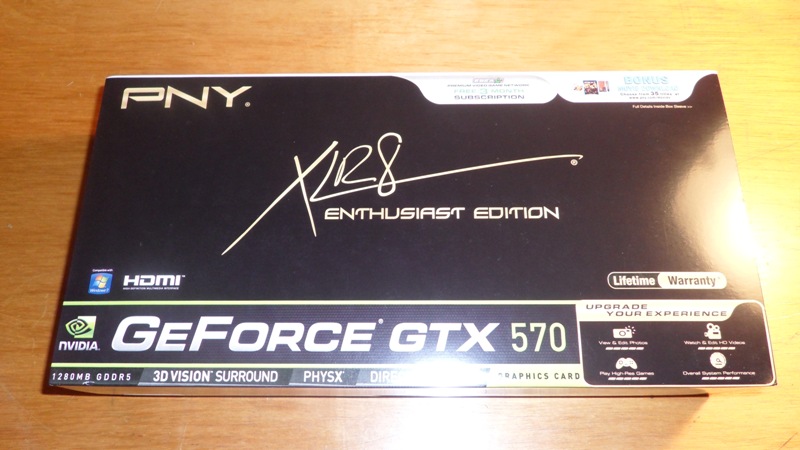
After recently experiencing a significant surge in equity on my 18 month-old ATI Radeon 5850 (Thanks, Bitcoin!), I sold it and moved up to an Nvidia GTX 570. I'm rather pleased at this opportunity because I was looking for a reason to get out from under ATI. As I explained in my 5850 review from January 2010, the only reason I went with ATI is because Nvidia did not have a competitive card at that time. Burdened by development and manufacturing issues, Nvidia released the GTX 480 six-months later. It was clearly superior to ATI but at a consequence of being too big, loud, hot, and power hungry.

OPPOSING FORCES

Aside from the obvious divergence in calculating Stream Processors, the 570 now closely mirrors the 5850 with Nvidia's adoption of GDDR5 memory, a larger frame buffer, more transistors and a smaller 40nm die. The 570 is more evolutionary than revolutionary, which in this case, isn't necessarily a bad thing. It takes the brute force of the GTX 480 but improves upon it with multiple architectural enhancements. Believe it or not, my new 570 more visibly resembles my old GTX 260 than it does the GTX 480 it replaces. The 480 looks like something a bunch of Nvidia interns constructed during an industrial arts class at Santa Clara community college. Exposed heat pipes were bent around the side of the card, a metal grate ventilated the heatsink, and holes were drilled into the back PCB ostensibly so it wouldn't spontaneously combust. When Nvidia code named the 480 "Fermi", they didn't realize how appropriate the nuclear namesake would be.

To that end, Nvidia's first order of business was taming the intense heat generated by the 570. To accomplish this, the engineers borrowed a page from the history books and returned to the enclosed coolers that it used on the GTX 260. They sculpted the plastic shroud that encases the 570 for maximum airflow and while this was a step in the right direction, more cooling was still needed to suppress the high temperatures. For that, Nvidia scrapped the 480's heat pipes and introduced Vapor Chamber Cooling (VCC) technology. Granted, VCC has been available in the aftermarket segment, but it marks the first time Nvidia has used one in a reference design. Additionally, the absence of heat pipes means better transference between the GPU’s heatspreader and the aluminum heatsink which results in improved cooling. Ironically, Nvidia borrowed the fan design from ATI's 5850 when it redesigned the fan on the 570. With a new integrated top ring, the fan is not only quieter but flows more air as well. And lastly, despite packing the new Vapor Cooling Chamber and 3 Billion transistors, the 570 is remarkably a half-inch shorter than my 5850

POWER TO THE PIXELS

So what's the payoff of all that research and development? Given the 570's extra processing muscle, Nvidia did a great job keeping the temps and noise inline with the less-powerful 5850. Aside from a slightly higher power draw and GPU temp under full load, the 570 is otherwise as friendly on the ears and electricity bill as a 5850. As expected, the PNY installation disc that shipped with it was woefully outdated-- the drivers were 266.77 from February and the two Nvidia demos (Supersonic Sled and Garage Installer) were both from the GTX 480's launch over a year ago. What they did include the most of was Nvidia wallpapers (18 to be exact), though curiously it plays like a Who's Who of past brand mascots starting with Dawn from the 2002 FX series, Mermaid Nalu from the 6800 in 2004, a couple Verto Fire, and the rest are devoted to Adrianne Curry in wallpaper sizes ranging from 1024x768 to a whopping 2560x1600. Curry has sinced moved on from her 2006 stint as Nvidia's poster girl and is now pitching The Flex Belt. With such a diverse menagerie of advertising icons, why not bring back the Werewolf? At least, Twilight and Teen Wolf fans might appreciate it.

BENCHMARKS

All tests were run on my system which consists of Windows 7 Ultimate 32-bit with a Q9650 Core 2 Quad overclocked to 3.33 GHz, GIGABYTE GA-EP45-UD3R mainboard, Antec 650W power supply, Seagate Barracuda 250GB 7200 RPM 16MB Cache SATA 3.0Gb/s Hard Drive and 4GB OCZ Fatal1ty DDR2 memory. While the 5850 recorded a score of 7.7, the 570 marks the first piece of hardware that maxed out the Windows 7 Performance Index with a 7.9 rating.

For the 570, I used the newest 275.33 WHQL drivers from June 1st and the most recent 11.5a Hotfix Catalyst drivers for the 5850. While I chose to keep the 570's factory settings, I overclocked the 5850 from the stock speeds of 725/1000 to 775/1125, the most permitted by ATI's Overdrive software. All tests were run in DirectX 11 at 1920x1080 with effects set to maximum except Crysis 2 which used DirectX 9. At the time of this testing, Crytek did not have a DX11 update available.

3DMARK 11: Although Unigine developed the first DX11 benchmark, 3DMark 11 shows why Futuremark remains the one to beat when it comes to video card testing suites. Whether underwater or in the jungle, the next-generation graphics are as astounding as they are demanding, dragging even the mighty 570's frame rate down into the single digits. On the Extreme 1920x1080 setting (1080p), the 570 scored X1811 3DMarks, a 31.5% improvement over the X1376 of the 5850. If that improvement percentage looks a little low, it's because 3DMARK 11 is a mixed bag of CPU and video tests. Had the scores been solely based on video card performance, the disparity between the two would have been much more pronounced.

CRYSIS 2: Even with absent DX11 support, Crysis 2 takes top honors for the most gorgeous first person-shooter. And with all settings on "Hardcore", the 570 was almost 50% faster pulling down an average of 65.23 FPS to the 5850's 45.98 FPS. It was also interesting to notice Crysis taking advantage of the 570's larger Frame Buffer: Memory usage for the 5850 was recorded at 1009MB while the 570 was tapped for 1171MB. Overall, I think Crysis 2 is the best representation here of the gains to expect when moving from a 5850 to a 570.

DiRT 3: Codemasters is on a roll (literally) with the DiRT series and this one raises the bar again for all driving games. Despite being optimized for ATI hardware, the 570's minimum frame rate of 53.8 was still higher than the 5850's average of 50.5 (strangely, the maximum frame rate was not available). Here, the 570 was 26% faster during the average frame rates and 28% faster during the minimum frame rates. Oddly, even selecting the "Ultra" preset did not fully enable all settings to maximum. Some items such as Night Lighting, Crowds, and Cloth remained on High. Initially, I thought this might be a limitation of the 5850's older architecture or 1GB Frame Buffer, but the 570 and it's nearly 30% larger Frame Buffer fared no better. Also, I noticed that there is a bug with the 570 that causes DiRT 3 to randomly lock up between races. Fortunately, I was able to bypass this issue by running it in a 1920x1080 window but such a game-stopping error is inexcusable.

UNIGINE HEAVEN 2.0: As noted by the suffix, this is the second generation of the benchmark, and it continues to offer possibly the best showcase of hardware tessellation. Clearly, it's not as beautiful as 3DMark11, but it is much more forgiving on extreme settings. For the overall score, the 570 was a whopping 80% faster than the 5850 with 1,465 points to 806 and this trend continued in the actual frame rates with the Nvidia averaging 58 FPS versus the ATI's 32 FPS. Switching to an Nvidia card also finally corrected my ongoing problems with flickering black bars in both versions of the Heaven software. I had corresponded with the Unigine developers about it but they were never able to pinpoint a solution.

CONCLUSION

Obviously, the 570's average 50% frame rate improvement isn't enough to warrant shelling out $350 for one if you already have a 5850 or newer card. That notwithstanding, it was impressive to see how much smoother and better the games performed as the benchmarks failed to tell the whole story. And gimmick or not, the inclusion of the PhysX effects in Crysis 2 (as well as many other new and forthcoming games like Alice: Madness Returns) is a welcome benefit as well. Additionally, the 570 allowed me to attain the magical 60 FPS average in both games at 1920x1080 with all options enabled which is a feat no console can duplicate.

Each year, the graphics cards get more powerful and the games look better, and I'm loathe to wonder when the cycle will end? However, after seeing how incredible 3DMark11 looked and how poorly it performed, I know there's still a few more generations of graphics cards ahead before we hit a glass ceiling. And that, my friends, is very good news.


Friday, March 11, 2011

GOODBYE, 1997 SATURN SC2!

Well, after 9 years and 110,000 miles of ownership, I finally decided to sell my SC2. I bought it on February 14, 2001 with 65,000 miles on the odometer so it really was fourteen years old with 175,000 miles when I sold it. The clutch was getting spongy, the air-conditioning had not worked in two summers, and the transmission refused to engage first gear. Repairing those items would cost more than it was worth so I found a good home for it in Ocean Springs.


Friday, November 12, 2010

RED LINE DYNO RESULTS

I had my first trip to the dyno at JMS yesterday. Despite my RL being factory rated at the flywheel for 205hp @ 5600rpm and 200 lb-ft of torque at 4400rpm, it actually made 238hp @ 6400 and 209 lb-ft of torque at 4400rpm at the front wheels. Factoring in a conservative 10% drivetrain loss, that means my Saturn is actually making 260hp at the flywheel. With these excellent results, I'm looking forward to the GM Performance Stage II upgrade which should put me close to 300 flywheel horsepower!

Check out the video I threw together and the dyno chart below:


Friday, July 16, 2010

ION STORM!

It's hard to believe (for me, at least) that May 1st 2010 was the twentieth anniversary of Pirate Press Publications. Pirate Press began life in the Computer Science lab at South Alabama where I toiled away creating the article on a word processor and printing it off on a dot-matrix printer. Despite that milestone, I'm afraid I have to admit that Pirate Press is a victim of the old adage, "The more things change, the more they stay the same". Two decades ago, the first issue of Pirate Press was devoted to a test drive of a 1991 Toyota MR2 Turbo. It was a complete redesign from the first generation MR2 and as such boasted an all-new 2.0-liter turbo four-cylinder generating 200hp. It was quite a sports car for that time period, but I was sure (like most of Generation X) that by 2010 we would have flying cars. Unfortunately, the concept of flying cars is laughable now as our future utopia never materialized and the global economy is on the verge of collapse. As such, and completely without intention, my new car ended up being remarkably similar to the one that launched Pirate Press a fifth-century ago.

I decided on another Saturn primarily because the Ion Red Line is the car I always desired my 1997 Saturn SC2 to be. Early on, I wanted to add a supercharger or turbocharger to the SC2 but it wasn't feasible from a practicality or expense standpoint. A full custom turbo kit could run as high as $4000 and require near daily ministrations to prevent an oil spill similar to BP's Deepwater Horizon drilling rig. On the other hand, a supercharger was only slightly less expensive and necessitated removing the air-conditioning, something not acceptable during half of the year in Mississippi. Furthermore, the stock 1.9-liter LL0 motor was not built to withstand more than 5 lbs of boost or two hundred horsepower (whichever occurred first).

Sure, GM killed Saturn along with Hummer, Oldsmobile and Pontiac last year but I have a history with Saturn, unmatched by any other car brand, that stretches back to 1992 when we purchased our first one. In that time, my family and I have accumulated over half-a-million miles in Saturns. We accrued nearly half that amount on our 1992 SL1 which was sold to a family friend in 2002 with 220,000 miles on its odometer. Next up, was a 1997 SL2 which we sold with 125,000 miles, and following that was my wife's 2001 L300 which we traded-in with 110,000 miles on it. Finally, there's my SC2 daily-driver that is fourteen-years old and has 167,000 miles on it.

In fact, the whole weekend of driving to Daytona Beach on May 1st to pickup my Red Line after purchasing it on Ebay was eerily similar to how we procured our Saturn L300 from nearby Jacksonville, Florida six years earlier. And in fact, it almost didn't happen because I nearly pulled the trigger on a 2004 Red Line in Las Vegas last year. Now, I'm glad I waited as the Red Line I bought has to be one of the nicest in the country. It was purchased new at Saturn of Daytona Beach and was registered in nearby New Smyrna Beach. With a total production run of just 5,827 vehicles between 2004-2007, there are actually fewer Ion Red Lines than Ferrari Testarossas. My silver one-owner example has a low 29,000 miles on it and is one of only 274 built in 2006. The '06 model is actually the most desirable, as the 2004-2005 cars had the wiring reversed on the intercooler pump causing it to malfunction or burnout, and the 2007 lineup did not have the Recaro seats. The Red Line was in concours condition and still even had the original 215/45-ZR17 Dunlop tires. Normally, I wouldn't be thrilled about the factory rubber but in this case it proved that the car wasn't abused. As it stands, I think the former owner was probably a little neurotic and possibly obsessive-compulsive as well. I base this assumption on evidence I gathered while stranded in a deserted Daytona Beach Industrial park. You see, MapQuest steered us wrong on Tomoka Farms road so we were the recipients of an unwanted twenty-five mile urban sightseeing tour of downtown Daytona that culminated at the dead end of a dirt road that looked like something out of Resident Evil. It was here that I discovered that I could not engage the reverse gear so I dutifully retrieved the owner's manual from the glove box. Upon so doing, I discovered a Da Vinci code of highlighted passages in the owner's manual. Sentences and sometimes entire paragraphs were swathed in vivid marker colors such as sky blue, fluorescent pink, day-glo orange and bright yellow. Clearly, the previous owner had some system of correlation between the colors and the subject matter but I never did crack the code, nor did I figure out how to back the Saturn out of there. Fortunately, I was able to pull forward and we escaped the abandoned area before the seemingly imminent horde of zombies arrived.

Once back at the hotel, I called my salesman to inquire about the reverse gear problem. As soon as I told him I couldn't get the vehicle into reverse, he erupted into uproarious laughter which was somewhat comforting, but also a little disturbing. "I thought you had owned a Saturn!?!" he blurted out before instructing me on how to disengage the reverse-gear lockout. I informed him that I had owned four other Saturns, and had driven many performance cars including several Ferraris, and had never come across such an issue. Despite that, the Gary Yeomans Ford dealership we visited is actually one of the largest in the U.S. as well as the top-selling Roush Mustang dealer in the nation. This is somewhat paradoxical because despite Daytona's reputation as the most popular beach in the world, it's pretty small as far as Florida's metro cities are concerned. With a population of just 65,000, that's scarcely grown any in twenty years; it's larger than Panama City but smaller than Pompano Beach. And with a median family income of $33,000, most of the residents cannot even afford one of Gary Yeomans' best-selling $50,000 Roush 427R Mustangs. Due to that, a large amount of the business the dealership does is out-of-state and overseas. In fact, the very first Ford GT was delivered to Gary Yeomans and promptly shipped to the Middle East. The same goes for their initial allotment of 2011 Shelby GT500s which also were all sold abroad.

Daytona is a sleepy beach town that just happens to host a NASCAR Speedway and the infamous Bike Week. But what really attracted me was the copper-streaked sand, which stands in stark contrast to Florida's typical sugar-white beaches. However, the unusual sand is what makes Daytona Beach one of the few places in the world where a car can be driven on an ocean beach without fear of getting stuck. This was the impetus for the original Daytona Beach Road Course and is what spawned the Daytona Speedway in 1959. We drove by the Speedway and you just can't miss it. It's a foregone conclusion that it has to be big for race cars to circulate at 200 mph, but television coverage simply doesn't do it justice. Honestly, the size of it reminds me of Downtown Disney.


DELTA FORCE

The 2003 Saturn Ion was the first car to debut with GM's all-new Delta platform. Obviously, it's a tremendous improvement over my 1997 SC2's tired Z platform which (unbelievably) traces its roots all the way back to the 1965 Corvair. Furthermore, the structural integrity of the Delta platform allowed the engineers to eschew any type of strut-tower brace which is usually necessary in such high-performance applications. The Red Line's wheelbase is only an inch wider than my SC2 but the extra five inches in length gives a lot more legroom and luggage space. And where the SC2 feels cramped and claustrophobic, the Red Line's cabin is positively cavernous in comparison. Adding to the driving comfort is a pair of grey leather Recaro sport seats which are hands down the best seats I've ever used. The deep side bolsters fit snugly and the firm lumbar support was a godsend for my lower back on the 550-mile trip. It's no wonder Recaros are standard equipment on both the new Ferrari 599 and Lamborghini Gallardo.

With the Red Line being the first vehicle I've owned that came from the factory with a CD player (I know-- I'm an audiophile luddite) I'm a little ashamed to admit that I haven't so much as turned on the radio. And it even has a factory amp mounted in the trunk which is another first for me. I can pretty much cop to using everything else during the 8-hour trip like the cruise-control, headlights, turn signals and windshield wipers which I painfully discovered were in dire need of replacing. Eventually, I suppose I'll have to turn on the radio if for no other reason than to change the clock from Eastern to Central time.

The Delta frame's front-strut and torsion-beam rear suspension provides a lot more stiffness over my SC2 without a harsh ride. Larger antiroll bars, heavier springs and firmer damping work in conjunction with the aggressive Dunlop 215/45 Z-rated tires on 17x7-inch forged wheels. GM engineers lowered the ride height by 10 millimeters over the regular Ion while raising the braking performance. Bosch 4-channel, 11.6-inch anti-lock vented front rotors replaced the 10-inch stock units while the rear drums are swapped out for 10.6-inch solid rear rotors. The brakes work so well that they halt the Red Line from a 70 mph panic stop in a scant 165-feet. In contrast, my SC2 needs another twenty feet to stop from the same speed. And as anybody who's ever been in an accident can attest, sometimes even a few inches can be the difference between danger and disaster.

RED WHINE

The Red Line's raison d'être is the Eaton M62 supercharger. If that names sounds vaguely familiar, it's because the M62 has been used in a variety of applications from the pedestrian Pontiac Bonneville SSEi to the exotic Lotus Exige. It's a real workhorse that doesn't even require a fluid change until 100,000 miles and is still going strong on several Red Lines with mileage's north of 150,000. To make the standard Ion's mild-mannered 2.2-liter Ecotec capable of handling the forced induction, GM's Performance Division destroked the engine to 2.0-liters and fitted new oil jet-cooled pistons with larger connecting rods that dropped the compression from 10.0:1 to a more supercharger-friendly 9.5:1. The Ecotec was also beefed-up in other areas too: A new 8-bolt steel crank protects the bottom-end while bigger intake valves enhance the breathing up top. A heavy-duty alternator helps cope with the extra power demands and the Red Line also gets Electronic Throttle Control (ECT) which utilizes an electronic signal, rather than a traditional cable, for immediate throttle response. Lastly, the engineers even borrowed the old drag-racer's trick of moving the battery to the trunk for better weight distribution.

To keep the Red Line out of the redline, a factory air intake with a cone-shaped filter was designed and it flowed so well that Chevrolet adopted it for the Trailblazer SS's 400hp LS2. Further cooling takes place courtesy of a Laminova air-to-liquid intercooler that circulates engine coolant through a heavy-duty radiator with larger fans. Maximum boost is limited to 12 psi which generates 205 hp and 200 lb-ft of torque for increases of 60 hp and 55 lb-ft over the standard Ion. The Red Line also benefits from a lighter flywheel and a stronger F25 five-speed transmission with one-inch shorter throws. Additionally, the driveline has a higher torque capacity and thicker, equal-length half shafts are used to minimize torque steer. Finally, to expedite delivery of the spent gasses, the narrow 1.75-inch factory exhaust was scrapped for a larger 2.5-inch system with a high-flow catalytic-converter and low-restriction muffler.

QUICKSILVER

With more mechanical upgrades than Iron Man, the Ion Red Line leaves my hot-rodded SC2 in the dust. A standard Ion with the 2.2-liter 140hp engine pokes along with a 0-60 time of 8.4 seconds and a quarter-mile in 16.5 seconds at 85 mph. My modified SC2 with an Injen intake, JG Big-Bore throttle-body, high-performance motor mounts, Hotshot header, test pipe and Thermal R&D Exhaust has run a 7.1-second 0-60 and a 15.8 at 91 mph. The Red Line rips to 60mph in 5.9 seconds and speeds through the quarter in 14.4 seconds at 100 mph. That performance even puts it ahead of the 15.2 at 96 mph I recorded in my modified Mustang GT at Gulfport Dragway. And it will match the Mustang in top speed also by charging up to 145 mph.

But while the Mustang was a one-trick pony, the Red Line is as adept on a race track as it is on a drag strip. GM's Performance Division spent months tuning the Red Line's suspension and handling characteristics at Germany's famed Nürburgring. According to Performance Division chief Mark Reuss, the Ion's much-maligned electronically-assisted steering has been tightened from 3.5 turn’s lock-to-lock to 2.9 which results in much more realistic feedback. The result is a stock Red Line covered the 33 left turns, 40 right turns and 170 bends of the Nürburgring’s 14-mile-plus Nordschleife circuit in a tick over nine minutes. By comparison, a Corvette C5 does it only twenty seconds faster.

THE DAWN PATROL

Determined to get an early start for the eight-hour drive ahead of us, we left Daytona Beach at 6 a.m. Unwittingly, my route to I-95 had us taking A1A through Ormond Beach to Flagler Beach. Granted, it wasn't the most efficient path but the scenic thirty-mile drive between the sand dunes and yucca bushes as the sun rose over the Atlantic was absolutely breathtaking. On that early Sunday morning, there wasn't any other traffic and it gave the experience a strangely surreal quality. Every car enthusiast has a mental list of their unforgettable drives and it ranks right up there with a trip I'd taken down Pacific Coast Highway from Monterey to Pfeiffer Beach in 1994.

Flagler Beach is split in two by the Intracoastal Waterway and sits on the Atlantic Ocean. It's also the only place I even remotely dipped into the boost for the length of the trip. We had been caught by a red light at the bottom of the Flagler Beach Bridge and I was beside a small Audi that looked maybe to be an A4 or A6. As the light turned green, we both accelerated away briskly and I short-shifted into third at around 40mph. I then flat-footed the throttle and the Red Line's demeanor immediately changed. It surged ahead with a startling urgency and I could hear the intoxicating whine of the supercharger. Within a couple seconds the speedometer was passing 80 mph and I was hard on the brakes. Hard to believe, but it's been 18 years since I've had that kind of a rush behind the wheel of a car I owned.

LIFE IS A HIGHWAY

Once on I-95, I settled in for the long haul with the cruise-control on 75 mph. The a/c was blowing a steady stream of cool air and it was a welcome relief from Florida's famous humidity, particularly since the air-conditioner hasn't worked in my SC2 for the past two summers. The interior of the Ion features a styling exercise that leaves people fiercely divided-- they either love or hate the McLaren F1-style center-mounted dash. Granted, to a casual observer the placement looks awkward, but I found it to be remarkably intuitive and after a few minutes I completely forgot it was there. The Red Line's euro-influences are abundant in the chrome-rimmed instrumentation where the gas gauge doesn't have a traditional "F" for full and "E" for empty. Instead, a full tank is denoted by a full-circle and an empty tank is a quarter-full (or some would argue, quarter-empty) circle. When the needle completely drops to empty, a "Low Fuel" warning message is activated and I've deduced that exactly one gallon remains in the tank. Depending on driving style, I've heard of owners averaging 22 mpg with a heavy foot while I managed 27.75 mpg from the combination of city and highway driving. The Red Line's gearing has been leveraged so that the supercharged motor turns fewer revolutions per minute than the one in my SC2. At 70 mph, the Red Line is loafing along at 2750 rpm while the higher-strung SC2 hits 3100 rpm. Obviously, this is favorable for fuel-economy as well as reduced engine wear, but I still can't expect the Ion to match the SC2's fuel economy since it carries more mass and has more horses to feed.

By sheer coincidence, we ended up at the same Florida Mile Marker 162 rest area that we had stopped at on our trip back from Jacksonville in 2004. I evangelized the thrills of it then in my Pirate Press review, and was pleased that it had not changed any. Looking like it was designed by an out-of-work Formula 1 architect, the asphalt snakes around with elevation changes and sweeping turns on both the entrance and exit. The stock Dunlops were not in the best condition for such an exercise but it did give me a brief opportunity to probe the Red Line's performance envelope. On one of the heavily-radiused turns, I began dialing in more speed, feeling what the car was doing. The speed-sensitive steering was nicely-weighted, with just the right amount of communication. The harder I pushed, the more the Red Line flattened out into a very neutral arc with safe and predictable handling. As the speed climbed, I heard the tires start to squeal in protest so I knew the limit was very close and backed off. Unlike a legitimate road course, there wasn't the safety of a run-off area if I overcooked a corner.

NEGATIVE IONS

At a dry weight of around 2,800 lbs, the Red Line outweighs my SC2 by a whopping 500-lbs and the additional high-performance parts bump it 100-lbs over an Ion 3 Quad-Coupe. Despite Saturn's celebrated use of plastic for the ground-effects, spoiler and many interior pieces, it's a heavy car. Of course, heavy is relative when most new performance cars tip the scales close to 4,000 lbs. A decade of engineering separates my SC2 from the Red Line and it's no secret that those intervening years of safety-Nazi features and watchdog electronics have ballooned the weight. A drive-by-wire throttle is great until the sensor jams and the cruise control doesn't work for the two-hundred miles between Jacksonville and Tallahassee. With my sciatica flaring up, I began to ruminate about the simplicity and effectiveness of my SC2's ancient, cable-actuated throttle linkage. It also developed a check-engine code, P01189, when I got to Alabama that turned out to be for the supercharger inlet pressure sensor. Apparently, this is a common malady among Red Lines and I had Joe Bullard Cadillac (my nearest authorized Saturn repair facility) replace it for $250. They also found a leaking front axle seal that was fixed for an additional $300.

The first owner was obviously not a gear head because he opted for the fog lights in the $1,375 Competition Package over the boost gauge and Quaife limited-slip differential. I like to see that I'm getting what I paid for, and as such would appreciate knowing how many pounds of boost the blower is generating. Also, it seems GM purposely underrated the motor as Sport Compact Car measured 197 hp at 6450 rpm at the wheels on their Dynojet, which works out to 217 flywheel horsepower given a conservative 10-percent drive train loss. The bad news is that research and development constraints kept the car from being even better: The 6450 rpm rev-limiter abruptly cuts the fuel to the cylinders even though the engine is still building power and the ECU artificially limits the supercharger's boost to 12 psi. Rick Kewley, GM Performance Division Manager, cites a truncated durability cycle as the reason for scaling back the Red Line's power.

Also, some interior materials don't seem to be as sturdy as in my 1997 SC2 which is three times as old and has over five times the mileage. The Red Line's black vinyl shifter boot is worn at the top and pieces began flaking off around the seams. The Saab-sourced five-speed is surprisingly notchy and the rubber clutch and brake pedal pads also need replacing as they are pretty filed down from use. Funny thing is, GM wants $50 for another vinyl replacement shifter boot or I can order an aftermarket handmade leather one with custom stitching for the same amount. Checking the cabin air filter behind the glove box revealed that it had never been changed and explained why the air flow felt weak. It also proved that virtually nothing on the car is easily accessed as I sliced my index finger on the sharp plastic edges. Such doesn't bode well for my maintenance plans of changing the fuel filter, oil filter and air filter. I've read comments that just changing the air filter is a two-hour job as it's tucked under the supercharger. In the Ripley's Believe-It-Or-Not category, our seven-seater Freestyle SUV boasts a dead-pedal but the performance-oriented Ion does not. Additionally, rearward visibility is crippled by the optional Ferrari F40-style deck lid spoiler and the exemplary Recaros seem very vulnerable to stains; I spilled some water on the driver seat and it left a nasty spot. However, a Recaro representative suggested that I use Blue Coral's Dry Cleaning Foam to remove such blemishes.

Saturn recommends 91 octane for the Red Line, but I doubt the Ford dealer sprang for premium fuel so I was conscious not to exercise it too hard until I had a chance to fill-up with Chevron's 93 octane which was $3.35/gallon in Tallahassee. And speaking of expensive fluids, the Red Line, like the Dodge Viper, Nissan GT-R, and entire Porsche lineup ships from the factory with Mobil 1 synthetic oil. Furthermore, the Red Line requires a staggering seven quarts for its small 122 cubic-inch motor which is more than was required by my Mustang's 302 cubic-inch V8. At around $7 per quart, it looks like I may have to take out a small loan for each oil change.

CONCLUSION

Aside from the 550-mile trip back from Daytona Beach and the 60-mile trip to the dealer, I've only driven the Red Line a handful of times in the first two months of ownership. However, I did manage to run it once down my legendary test strip, which is a stretch of pavement near my home. If I had to guess, I'd say it's roughly 1000-feet, as it's longer than an eighth-mile but shorter than a quarter-mile and I've tested every vehicle I've owned (and even some I haven't) since 1990 on it. My SC2 consistently pulls 79 mph through it and my Red Line's one run yielded 90 mph which is right in line with expectations. Tack on another 10 mph for the last 320-feet and it has my Red Line clearing the quarter-mile at 100 mph. Regrettably, prior to that run I tagged the rev-limiter when I discovered that the motor revs so furiously that the tachometer lags behind the actual engine revolutions by about 500 rpms. As such, I have to shift at an indicated 6000 rpm to match the 6500 rpm redline on the instrument cluster.

Regardless, the build and ride quality makes the Ion feel like a Cadillac in comparison to my SC2. And GM offers three different Stage kits with such things as larger fuel injectors and a smaller supercharger pulley to significantly increase the Red Line's horsepower. In fact, Eaton even makes a bigger, direct-replacement supercharger that's good for 300 horsepower. With the SC2, the addition of the header, off-road pipe and Thermal R&D exhaust made for a very raspy, ear-ringing exhaust. So as much as I'd like to get rid of the catalytic converter on the Red Line, I'm going to resist the temptation. I'm determined to upgrade it but not at the expense of the daily driveability. That notwithstanding, I'm looking forward to a lot more seat time and even a trip to the dyno this fall.


Friday, April 02, 2010

Fourplay: Q9650 Quad-Core Benchmarks

It's been almost exactly four years since I first upgraded to a dual-core processor. Prophetically, I concluded the article with the statement, "Make no mistake, dual-core CPUs are here to stay". In retrospect, perhaps I should amend that to read, "multi-core CPUs are here to stay" because it's clear that with future applications, there is no room for just a single-core or even dual-core processor. In fact, it's becoming increasingly difficult for a mono-core processor (even a relatively fast one like a 3.2GHz Pentium 4) to successfully handle several tasks at once such as running a virus scan, checking email and editing a Word document.

For the past couple years, I've observed the maxim that it's better to run a high-clocked dual-core rather than a slow-clocked quad-core as few applications and games utilized more than two cores. However, with the release of Battlefield: Bad Company 2 and DiRT 2, I can no longer ignore the need for a quad-core processor. Granted, they're both demanding games, so I initially dismissed the occasional choppiness as a limitation of the video card. But I was still puzzled as to why my brand new Radeon 5850, one of the fastest video cards available, would be struggling. Finally, I spotted the problem when I checked the task manager and saw that both games were completely maxxing out my dual-core E8500.

It was September 2006 when Intel unveiled the first quad-core processor at their annual developer conference. The Core 2 Extreme QX6700 was built on the Kentsfield core, featured 8MB L2 Cache, a 65nm fab, and a 1066MHz FSB. It was clocked at 2.66GHz and cost $1,000. Originally, it was used to showcase the game Alan Wake and its multi-threaded ability to utilize four processor cores and run entirely on DirectX 10. However, this has become a sore spot among computer enthusiasts as it was recently announced that when Alan Wake arrives this summer, it will be an Xbox 360 exclusive. The irony is palpable as the Xbox features neither a quad-core processor nor DirectX 10.

Despite that letdown, Alan Wake did provide us a glimpse into how a brand-new multi-threaded PC game such as Battlefield: Bad Company 2 might use a quad-core processor. The game spawns five independent threads which are for Audio, Physics, Rendering, Streaming, and Terrain Tessellation. Obviously, the Audio thread is responsible for all sound in the game, and it is also said to be one of the least CPU dependant. Conversely, the Physics thread can be the most demanding, consuming up to 80% of one core by itself, particularly if there is no hardware support such as PhysX. The Rendering thread organizes the data to be sent to the GPU for display, while the Streaming thread loads the game off the hard drive. By dedicating one thread to this, it helps the game seamlessly transition from one area to the next. Finally, the Terrain Tessellation thread is tasked with procedurally generating the environment as it unfolds, which helps minimize objects popping into view. A key benefit of DirectX 11 is hardware tessellation but to what degree it is implemented in the DX11 portion of Battlefield is currently unknown. Regardless, with new and future multi-threaded games, it's very easy to see why even dual-core processors are no longer capable of properly supporting them.

After much deliberation, I decided on a 3GHz Core 2 Quad Q9650 to replace my 3.16GHz Core 2 Duo E8500. It was the path of least resistance and allowed me to keep my current setup and simply swap out the CPU. Frankly, with Intel's over-inflated prices of their last-generation Core 2 lineup, I could have purchased a new Socket 1156 motherboard and Core i5 processor for the same $330 that the Q9650 cost. But that's just Intel's way of trying to force customers to buy their newest chips. Still, it's quite a premium considering that the 2.83GHz Q9550 is $100 less and the 2.66GHz Q9450 is $200 cheaper. Essentially, I'm paying two benjamins for a paltry 340MHz. However, as I learned later with the benchmarks, megahertz still plays a very important role no matter how many cores are available.

HEATSTROKE

The Q9650 benefits from several architectural improvements over Intel's original quad-core QX6700. For starters, the Q9650's core is code named Yorkfield and possesses 50% more L2 Cache (for a total of 12MB), a smaller, more efficient 45nm fab and a faster 1333MHz FSB. In essence, it's basically two 3.0GHz E8400's joined together. However, the stock fan and heatsink are the same that shipped with my two year-old E8500 and is remarkably cheap considering the $330 price tag. In retrospect, I'd have been better off removing the motherboard and spending $25 on an aftermarket cooler rather than struggling with Intel's bargain-bin unit. Locking the heatsink in place so that it maintained direct contact was quite a feat and several times the entire PC shut down from overheating. At one point, I thought I might actually snap the motherboard in half trying to secure the fan. When I did manage to get it up long enough to check the BIOS, the CPU was hotter than a George Foreman grill. The temperature was a sizzling 200 degrees Fahrenheit, nearly double the safe operating limit. Eventually, with the motherboard removed (something I'd tried to avoid) and the fan fully secured, temps were closer to room temperature. And thankfully, like that New Year's Eve 1999 party, there was no permanent damage. But out of curiosity, I checked one of our new Dell workstations outfitted with a 2.4GHz Q6600 quad-core processor and noticed that Dell also eschews the ill-functioning Intel cooler. Dell's custom unit is comprised of a towering aluminum heatsink ventilated by a massive 120mm fan. It's both ultra cool and quiet-- resting temps were a chilly 30 degrees Celsius and even under full load it only spiked a little past 40 degrees. In comparison, my sweltering system operates at nearly double those values. Finally, it's worth noting that with the new Core i7 980X, Intel has adopted an entirely different cooling design that attaches via a back plate and four screws. My question is what took them so long?

DISCLAIMER: It's worth noting that these tests are more of an apples to oranges comparison, because the E8500 is heavily overclocked to 3.66GHz versus my choosing to run the Q9650 at its factory setting of 3.0GHz to get an accurate baseline. Had I chosen to return the E8500 to its original 3.16GHz speed, the difference would have been much more pronounced. However, because I run the E8500 continuously at 3.66GHz, I figured it would most accurately represent the true increase on a daily basis. Unfortunately, synthetic tests such as the ones below don't seem to accurately reflect the improvement I'm seeing in actual games. For this reason, I declined to use the results I'd gathered from SiSoft Sandra 2010 as they likewise seemed well off the mark.

3DMARK VANTAGE

Futuremark's DX10 extravaganza is growing long in the tooth, and a DX11 replacement is due soon, but it's still a very demanding benchmark. Typically, 3DMark is used to test the video card, but in this case I was more interested in the CPU tests. Sure enough, the GPU score was virtually identical, but the CPU tests reflected nearly a 70% improvement with the score leaping from the E8500's 7,250 to the Q9650's 12,260. Additionally, the CPU Test 1 bounced from 671 with the dual core to 1,070 with the quad-core and CPU-dependant physics tasks such as the Futuremark flags whipping in the wind were noticeably more realistic. Although Futuremark doesn't explicitly advertise Vantage as supporting four cores, it's clear that it does.

BATTLEFIELD: BAD COMPANY 2

I've joked that I bought a $330 processor to play a $50 game, but it's really not that much of a stretch. Although BC2 doesn't have a proper benchmark, the tangible difference between my overclocked E8500 and the Q9650 was extremely pronounced here. Prior to this installment, I'd never been a fan of the Battlefield series having just briefly tried the Vietnam chapter in 2004. I was hooked on Call of Duty: Modern Warfare 2, and was skeptical that BC2 could challenge it, but it certainly made a believer out of me from the first few moments. Unfortunately, the intermittent frame rate stuttering was distracting and was not letting me enjoy the game to its fullest degree. So when I forced the DX9 render path (instead of DX11) and saw no improvement, I knew the bottleneck was not the video card. A little research turned up my dual-core processor as the culprit and even after upgrading to a quad-core, CPU ultilization spread over all four cores was still heavy at 70%. Given the processor load, it seems like the Xbox 360's 3.2GHz PowerPC Tri-Core Xenon will be on the ragged edge of running this game.

CINEBENCH RELEASE 10

Ever since I first used Cinebench a couple years ago, I've been eager to try it with a quad-core processor as it can actually support up to 16 cores. For this test, I also threw the Dell quad-core workstation into the mix as I was curious how it would stack up against my homebuilt quad-core. However, the multi-threaded Cinebench made it clear in no uncertain terms that clock speed is still king. The 3.66GHz E8500 rendered the high-resolution image on one core in just 3 minutes and 30 seconds, the 3GHz Q9650 took nearly a full minute longer at 4 minutes and 25 seconds, and the 2.4GHz Q6600 labored behind at a lengthy six minutes. The roles were somewhat reversed on the Multiple CPU rendering as the Q9650's 3GHz and two extra cores helped it win the fastest time in a scant 1 minute and 14 seconds. Meanwhile, the megahertz-muscle of the dual-core E8500 posted a valiant effort of 1 minute and 56 seconds but the slower four-cores of the Q6600 barely edged it out with a time of 1 minute and 42 seconds. Unfortunately, it wasn't until after I'd benchmarked all three processors (and sold the E8500) that I discovered there was a newer version, Cinebench Release 11.5, available.

CONVERT X to DVD 4

Aside from the obvious benefit to gaming, I was equally excited to try the Q9650 for video encoding. I typically download several 700MB and 1.5GB AVI files per week and it takes anywhere from 12-24 minutes to encode one. The latest version of Convert X to DVD has an option whereby you can set the number of cores for the program to use. I converted a 1.5GB copy of Avatar with my dual-core E8500 overclocked to 3.66GHz which took exactly 24 minutes. With the Q9650's two-additional cores, it chopped the time in half to 12 minutes. Interestingly, Convert X doesn't seem to care about processor speed, as the time was exactly halved going from a faster dual-core to a slower quad-core.

DiRT 2

Without a doubt, DiRT 2 benefited the most from the quad-core upgrade. But as with the other programs, the DirectX 11 in-game benchmark failed to accurately confirm the significant improvement. It showed a minor increase in the minimum frame rate from 50 to 55 FPS and the maximum frame rate from 60 to 64 FPS. Yet those statistics fail to convey the sense of speed that had been missing from the game. I feel intimately acquainted with DiRT 2 because I played many hours of it in DX9 before I received my Radeon 5850. Following that, I started the entire game over because I wanted to experience it in its entire DX11 splendor. Now, despite nearly finishing it again, I have once more restarted it because the difference with four cores is so profound. In fact, the frame rate is so fast now that the game feels like it's perpetually stuck on fast-forward as the action unfurls like a projector reel that has jumped its sprockets. With the drop-dead gorgeous visuals and ultra-high definition environments, DiRT 2 is like watching car porn on Blu-Ray.

INTEL ICE STORM FIGHTERS

Surprisingly, not only is this the oldest benchmark in the group, but it's also the only demo that visibly displays the load on all four cores. That's because it was commissioned by Intel as a selling tool to promote their quad-core processors. Designed by Futuremark, it's not even DX10, but the blizzard of activity (think of the climatic snow battle on Hoth in The Empire Strikes Back) dragged my E8500's frame rate into the 30s. However, the Q9650 easily juggled the multi-core onslaught, while maintaining a solid 50-100 FPS depending on the action.

WINDOWS EXPERIENCE INDEX

This software first debuted in 2007, a not-so-subtle application designed to inform dim-witted customers why their computer was running so slowly with Vista. The arbitrary tests attempt to accurately rate your system on a scale of zero to 7.9 in Windows 7, but as I mentioned before, Windows seems to discriminate against anything less than four cores. My overclocked 3.66GHz E8500 registered a 6.9 on the scale, while the 3GHz Q9650's processor calculations per second net it a 7.3 score. Naturally, I take these "assessments" with a grain of salt, but they're still interesting nonetheless.

OVERCLOCKING

Obviously, I couldn't resist the urge for long before I tinkered with the front side bus. Overclocking from 333MHz to 370MHz yielded a new speed of 3.33GHz that made it faster than any Intel consumer quad-core you can buy-- the pricey QX9770 and Core i7-960 both top out at 3.2GHz. Considering each of them sell in excess of $500, it makes my overclocked 3.33GHz Q9650 suddenly seem like a bargain. Additionally, the 11-percent FSB hike didn't noticeably affect the CPU temperature, which was a blessing in itself considering what I had gone through with the overheating. As for the benchmarks, every application save Convert X benefited from the extra megahertz. Echoing what I observed earlier, Convert X required the same time to encode Avatar at 3GHz as it did at 3.33GHz, indicating that it is limited more by physical cores that processor speed. 3DMark's CPU score was boosted from 12,260 to 12,950 and CPU Test 1 went from 1,070 to 1,770. An additional 25 seconds was sliced from the single-core Cinebench test but the four-core test was just 8 seconds quicker. And finally, the Windows Experience Index reassessed my CPU with a 7.4 score.

CONCLUSION

I learned from this exercise that whether it's one or one-hundred benchmarks, sometimes there's no substitute for simply playing the game to get a "real-world" feeling for the improvement. Granted, it's easy for cynics to dismiss such a practice because it can be unduly influenced by a host of outside variables-- namely enthusiasm and excitement which can unrealistically inflate the perceived performance of the product. But when you've scrutinized certain programs dozens of times over a series of months or years as I have with the preceding games and benchmarks, you tend to develop a trained eye for the subject matter. Prior to my purchase, I'd read a lot of forum reviews where owners spoke enthusiastically of never being able to go back to a dual-core after using a quad-core and I can certainly agree with that. However, Windows 7 doesn't seem to boot any faster, nor do programs appear to load quicker. If anything, single-threaded software feels more responsive with the overclocked dual-core and the benchmarks bear that out. And even in multi-threaded applications like Cinebench, an overclocked dual-core is still nearly as fast as a slower quad-core. So for now, quad-core adoption is only encouraged if the individual user has enough applications to warrant it and can afford a fast one. But don't say I didn't warn you, because multi-core CPUs are here to stay.


Friday, January 29, 2010

ATI Radeon 5850 DirectX 11 Benchmarks

Frankly, after the fiasco I had in 2003 with an ATI Radeon 9800 Pro (BIOS-modded to XT specs) I never thought I'd own an ATI video card again. After all, ATI's Catalyst drivers don't seem to be as stable as Nvidia's, most games run better on Nvidia silicon, and the proprietary PhysX effects in new games like Batman: Arkham Asylum are only capable on an Nvidia graphics card. But this year, after owning eight different Nvidia products (16MB TNT, GeForce 3 Ti 200, GeForce 4 Ti 4400, GeForce 6800 GT, GeForce 7800 GT, GeForce 7950 GT, GeForce 8800 GTS and GeForce GTX 260), Nvidia dropped the ball.

In a move reminiscent of their unveiling the first DirectX 9 card, the 9700 in 2002, ATI beat Nvidia to market with the first DirectX 11 card, the 5800-series. Codenamed "Evergreen", its existence was first noticed at an AMD Technology Analyst Day in July 2007. Even more amazing is that Nvidia was apparently caught flat-footed by this and does not have an answer to ATI's new lineup. And if recent reports are to be believed, it will not have a DX11 competitor in retail channels until possibly March or April at the earliest.

But not everything's coming up roses for ATI. Problems with the 40nm chip production at TSMC meant that current demand for the new video card far outstripped the supply. And despite cards trading for $100 over MSRP at Christmas, the 5800-series was rarer than a straight guy at a Clay Aiken concert. In essence, it was a "perfect storm" of unavailability: competition from Nvidia not expected until Spring 2010, production facility operating at reduced capacity, and everyone wanting one for the holidays. In my twenty-five years of working with computers, I've never seen such a desperate situation where people were clamoring and fighting to buy one.

In fact, the state of affairs for an ATI card was so dire that I enlisted ATI's 5800-series launch partner, Dell, in hopes of securing one under my tree for Christmas. I contacted our Senior Accounts Manager with whom we annually spend $30,000 or more on computer-related purchases and inquired about the Radeons. The good news was I could order it at MSRP but the bad news was that even they were out of stock.

I placed my order on November 18th with shipment expected by November 23rd. However, on the 24th I received word that Dell's distributors, Tech Data and Ingram Micro, couldn't get stock either so the order was bumped back to December 4th with shipment to follow on the 8th. Finally, after the 8th had come and gone, I notified Dell to cancel my order as I was tired of waiting. Christmas came and went but on New Year's Eve I received an overnighted package from FedEx. I opened it to find a 5850 and a 5870.

I weighed my options and decided to keep the 5850 as I calculated the extra $100 premium of the 5870 didn't justify the minor 10-15% performance increase.

So what makes the new 5850 so much more desirable than my year-old Nvidia GTX 260?

Apart from the apples-to-oranges difference in Stream Processors (Nvidia's architecture is scalar, while AMD's is superscalar) the 5850 doesn't look that much faster on paper. Perhaps the most interesting item is the bus width and memory type where Nvidia and ATI are clearly divided. Nvidia prefers to use slower DDR3 memory with a wider 448-bit bus, while ATI goes with faster DDR5 in a narrower 256-bit bus.


LESS IS MORE

The GTX 260 sucks down kilowatts like the Rockefeller Center Christmas tree. At idle, it's consuming 160 watts and under load that spikes to 260 watts. Unfortunately, my five year-old APC 350 battery backup was not up to the tasking of powering it and my 22-inch LCD when the power unexpectedly went out during Hurricane Gustav in 2008. It took just three seconds to completely drain my battery backup. In retrospect, the GTX 260 probably consumes nearly as much wattage by itself as my whole system did when I originally purchased the APC 350. Amazingly, ATI has developed the 5850 with Ferrari performance on a Prius appetite. It idles at 27 watts and its full load of 151 watts is below what the GTX 260 consumes at rest. Considering how many hours a day my PC spends on, it's like replacing an incandescent bulb in my PC with a compact fluorescent light.

Although there are many brands of ATI 5850 cards, Dell was only able to get Visiontek cards. The first and last Visiontek card I owned was a GeForce 3 Ti 200 in 2001. It lasted maybe a year before it started artifacting heavily in games. I RMA'd it and received a new one promptly. About two years later, the replacement (then in my brother-in-law's PC) began turning the entire screen red during gaming. For whatever reason, Visiontek dropped off the map for a couple years only to emerge in 2005 selling Nvidia's chief competition, ATI video cards. And they seem to have done very well at it-- in 2008 they were ranked #1 among all ATI's North American channel partners.

Despite the fact that the 5850 is nearly as large as my outgoing GTX 260, it shipped in a very compact box with minimal packaging. There was a single CD that included the Catalyst 9.11 drivers from November, and the hardware consisted of a 6-pin PCI-E power adapter and a strange DVI adapter. In fact, I had to forgo my fancy DVI cable and revert to a standard VGA cable to use ATI's proprietary display port. Also, I was bummed that they didn't include a demo disk or a free copy of DiRT 2 or Battlestations: Pacific as other 5850 vendors such as Polorcolor and Sapphire are doing.

Visually speaking, the Visiontek 5850 doesn't sport any wild or flashy graphics and instead comes in a basic matte black sheathed cover with a striking red fan. On the underside, the card is bare and doesn't even include a backplate. I tested it on my system which consists of Windows 7 Ultimate 32-bit with an E8500 Core 2 Duo @ 3.66 GHz, GIGABYTE GA-EP45-UD3R mainboard, Antec 650W power supply, Seagate Barracuda 250GB 7200 RPM 16MB Cache SATA 3.0Gb/s Hard Drive and 4GB OCZ Fatal1ty DDR2 memory.

For maximum benefit, I used the latest Nvidia Beta drivers 195.81 released on December 15th for my GTX 260 and the December 9.12 Catalyst drivers and ran all benchmarks at my 22-inch LCD's native resolution of 1680x1050. After reading all the horror stories about ATI cards, I was expecting the worst when uninstalling my Nvidia drivers and loading the Catalyst drivers, but it went remarkably smooth. Interestingly, on the Windows 7 Experience Index, the 5850 recorded a score of 7.7 (with 7.9 being the maximum). Previously, I had scored a 7.1 with the GTX 260.

BENCHMARKS

3DMARK VANTAGE: Two years ago, this was the first DirectX 10 benchmark available and it's still a very viable one, although the built-in PhysX support tends to skew the numbers favorably for Nvidia cards. For instance, as soon as I loaded it, it locked up with a physxloader.dll error. After correcting that, the 5850 excelled by a healthy margin of 55%, pulling down a GPU score of 14,268 to the 260's 9,208. In the Texture Fill Feature Test, the Radeon really flexed its muscles by nearly tripling the results of the 260 with 1451 GTEXELS/S to 554 GTEXELS/S. And for the math-heavy, Perlin Noise Pixel Shader Test, which stresses the arithmetic computing power of the graphics card, the 5850 hit 122 FPS, quadrupling the 32 FPS of the 260.

BORDERLANDS: Not only was Borderlands my favorite game of 2009, it's also one of the few current games to ship with a built-in benchmarking tool (although to be fair, it didn't work properly until the first patch). Unfortunately, the game does have quite a few bugs that still exist even after two updates and this clearly affects the benchmarks. And like 3DMark Vantage, which relies heavily on the PhysX library, Borderlands also initially crashed with a physxcudart.dll issue. As such, the performance disparity between the two cards was closer here than anywhere else. The 260 managed a minimum framerate of 21.76, average of 57.07, and a maximum of 130.91 while the 5850 hit slightly faster numbers of 25.03, 63.12 and 154.16. Additionally, Borderlands would periodically freeze up with the error that the ATI Display Driver has stopped responding. Because of that, future updates should dramatically improve the game's performance with ATI cards.

DiRT 2: Having played DiRT 2 for nearly a month on my GTX 260 before the 5850 fell in my lap, I can attest that it looks quite good and performs really well in DX9, knocking off a minimum of 55 FPS and a maximum of 71. But the icing on the cake is that the 5850 enables DX11's Shader Model 5, advanced lighting, and tessellated water effects with virtually no framerate penalty. The Radeon's minimum FPS was 55 and the maximum was 69 with DX11. And trust me, once you played it in DX11, there's no going back. However, I noticed that in actual gameplay (and not the demo benchmark) that DX11's framerate sometimes dips into the thirties. This can cause an occasional hitch, particularly during crowded events, but fortunately isn't too distracting.

S.T.A.L.K.E.R.: CALL OF PRIPYAT: Personally, I love S.T.A.L.K.E.R.'s X-Ray engine (see my initial review from February 21, 2007) but the actual game was a disappointment. Despite that, developer GSC Game World has done a great job incorporating DX11 into Version 1.6 of the X-Ray engine for Call of Pripyat. The full benchmark cycles through four tests: Day, Night, Rain and SunShafts and can be run in either DX9, DX10 or DX11. To stress-test the 260 as much as possible, I tested it against the 5850 in a DX10 head-to-head match as well as the 5850 individually in DX11. The 260 hit a minimum frame rate of 29 and a maximum frame rate of 138 while the 5850 achieved frame rates of 45 and 190. Amazingly, the 5850's frame rate dropped to just 38 and 184 when tested under DX11. However, this remains the only benchmark where I could not visually see an improvement with DX11.

UNIGINE HEAVEN: Unigine stole Futuremark's thunder by being the first to release a DirectX 11 benchmark and Heaven is presently the best showcase for DX11's hardware tessellation. Flat, two-dimensional walls and stairs magically gain depth and a dragon suddenly sprouts spikes sharp enough to cut you. Unfortunately, there also seems to be some issue causing missing textures as black bars randomly pop up throughout the DX11 demo. I've e-mailed Unigine about the issue and they explained a newer version of Heaven with more content would be available March 1st. Despite that, it doesn't seem to negatively impact the performance. Once again, the 5850 mopped the floor with the 260, pulling down better numbers under DX11 than the 260 could muster with DX9. The Radeon averaged 47.6 FPS for an overall score of 1198 while the GeForce trailed with 31.3 FPS and a 789 score. In DX11, the 5850 averaged 34.5 FPS for an 870 high score.

CONCLUSION
Primarily because the 260 performed so well in games like DiRT 2, I was hesitant to upgrade to a 5850. However, my fears were unfounded as I discovered not only was the 5850 a breeze to install, but it offers roughly 50% faster frame rates, full DirectX 11 support, and draws a heckuva lot less power. Plus, as the Catalyst drivers mature, the performance will increase. I'm not sure what Nvidia has up its sleeve for its GT100 "Fermi" DX11 card but I couldn't be happier with my 5850.


  Between Heaven & Houston 48 Hours in the Heart of Texas       Pirate Press             Autumn 2026   Bad Decisions Make Great Stories...